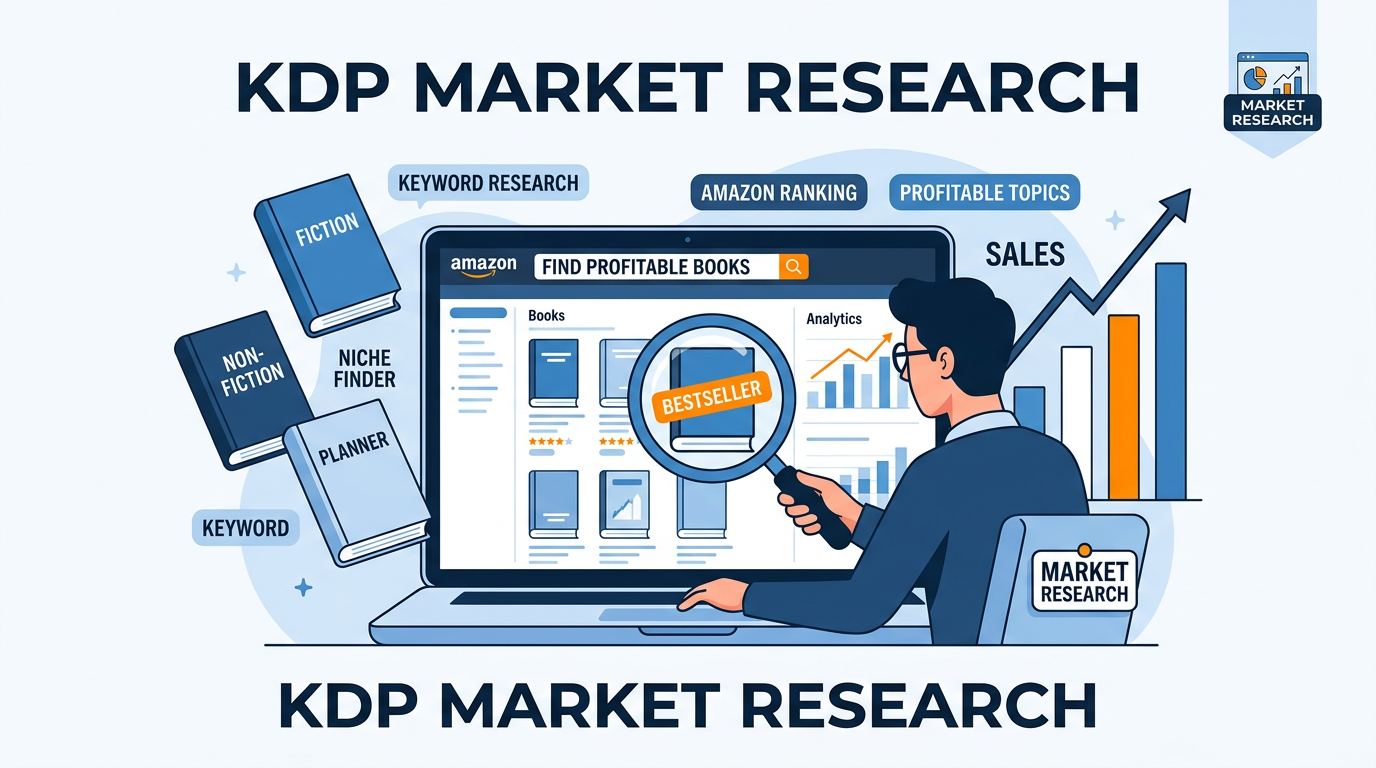
Every single day, thousands of new titles are uploaded to the Amazon Kindle Direct Publishing (KDP) platform. For many authors, the publishing process is driven by passion—a desire to share a story or a specific piece of knowledge. However, from a business perspective, publishing without thorough Amazon KDP market research is a gamble that rarely pays off. In the world of self-publishing, "build it and they will come" is a myth. The reality is that "research it, validate it, and then build it" is the only sustainable path to a full-time income.
Market research is the process of looking at the data before you write a single word. It is the difference between a book that languishes at the bottom of the rankings and one that generates consistent monthly royalties. This guide will move beyond basic advice and provide a deep, strategic dive into how professional publishers identify underserved niches, analyze competitor weaknesses, and position their books for maximum visibility and conversion.
The Psychology of the Amazon Shopper and the A9 Algorithm
To succeed on Amazon, you must understand that Amazon is not just a bookstore; it is a sophisticated search engine. Much like Google, Amazon uses an algorithm (often referred to as A9) to determine which books appear on the first page of search results. While Google prioritizes information relevance, Amazon prioritizes sales velocity and conversion rates. Amazon wants to show the customer the book they are most likely to buy.
Effective market research allows you to align your book with what the algorithm wants. When you find a niche where the demand (search volume) outweighs the supply (high-quality books), you have found a "gold mine." Your goal is to identify these gaps where customers are searching for solutions or entertainment but are currently unsatisfied with the existing options.
Phase 1: High-Level Niche Validation
Before diving into specific keywords, you must validate the "health" of a potential niche. A healthy niche has enough depth to support multiple authors making money, but not so much competition that a new author is buried by established brands.
Understanding Best Seller Rank (BSR)
The most important metric in KDP research is the Best Seller Rank (BSR). Every book on Amazon has one. The lower the number, the more copies the book is selling. For example, a book with a BSR of #100 is selling thousands of copies a day, while a book with a BSR of #1,000,000 might sell one copy a month.
When researching a niche, look at the top 10 books in that category. If the #10 book has a BSR under 100,000, it indicates that the niche has enough "oxygen" or buyer interest to be profitable. If the top-ranked books in a niche have BSRs over 300,000, it suggests there simply isn't enough demand to justify the effort of writing a book in that space. To estimate your potential earnings based on these rankings, it is helpful to use a Royalty Calculator to see how much profit you would actually retain per sale after Amazon takes its cut.
The "Top 10 Rule"
A professional strategy for niche validation is the Top 10 Rule. Look at the top 10 search results for your primary keyword. Ideally, you want to see at least three books with a BSR between 10,000 and 50,000. This range is the "sweet spot"—it proves people are buying, but the competition isn't so fierce that you are competing with celebrity memoirs or massive publishing houses with six-figure marketing budgets.
Phase 2: Strategic Keyword Intelligence
Keywords are the bridge between a customer's intent and your product. Most beginners make the mistake of choosing keywords that are too broad, such as "Cookbook" or "Self-Help." These are impossible to rank for. Instead, you need to find "long-tail keywords"—specific phrases that reflect exactly what a buyer is looking for.
Finding Underserved Long-Tail Keywords
Think about the difference between someone searching for "Fitness" versus someone searching for "Postpartum yoga for beginners with back pain." The second searcher has a specific problem and is much more likely to buy a book that addresses that exact issue. Your research should focus on finding these specific sub-niches.
One of the best ways to expand your keyword list is to use a Keyword Combiner. By taking core terms (e.g., "Intermittent Fasting") and combining them with modifiers (e.g., "for women over 50," "for busy professionals," "meal plans"), you can discover high-intent phrases that your competitors have overlooked. These phrases should be used in your title, subtitle, and the seven backend keyword slots in your KDP dashboard.
Analyzing Keyword Competition
Once you have a list of potential keywords, enter them into the Amazon search bar. Look at the number of results. If a search term returns over 10,000 results, it is highly competitive. If it returns under 1,000 results, it might be a hidden gem—provided the books that do show up have decent BSRs. The "holy grail" of KDP research is a keyword with high search volume and low competition (fewer than 2,000 results).
Phase 3: Competitive Gap Analysis (Review Mining)
Don't just look at what your competitors are doing right; look at where they are failing. This is a technique known as "Review Mining." By analyzing the reviews of the top-selling books in your niche, you can find a blueprint for how to make your book better.
- Analyze 1-Star and 2-Star Reviews: What are the common complaints? Is the formatting poor? Is the information outdated? Is it too "fluffy" without enough actionable steps? These complaints are your opportunities.
- Analyze 5-Star Reviews: What do readers love? What specific chapters or concepts did they find most helpful? Ensure your book includes these "must-have" elements.
- Identify the "Missing Chapter": If multiple readers say, "I wish this book had more recipes" or "I wish there was a checklist included," that is your cue to include those features and highlight them in your marketing.
By creating a book that solves the problems of existing titles, you give yourself a massive competitive advantage. You aren't just adding another book to the pile; you are providing the superior solution.
Phase 4: Visual and Technical Standards
Your research is only effective if your book converts browsers into buyers. This requires professional-level packaging. On Amazon, people do judge a book by its cover. In fact, the cover is the single most important factor in your Click-Through Rate (CTR).
The Role of the Cover
Study the covers of the bestsellers in your niche. Do they use bright colors or minimalist designs? Is the typography bold and easy to read even in a small thumbnail? You must design a cover that fits the expectations of the genre while standing out from the crowd. To ensure your cover meets the exact technical requirements for Amazon’s printing presses (especially for paperback and hardcover), use a Cover Calculator to determine the precise spine width and bleed margins based on your page count.
Optimizing Your Book Description
Your description is your sales page. Many authors simply paste a block of plain text, which is a major mistake. Amazon allows for basic HTML formatting in descriptions. Using bold headers, bullet points, and italics makes your description scannable and professional. A well-formatted description can significantly increase your conversion rate. To make this process easier, use an HTML Description Formatter to ensure your listing looks clean and enticing on both mobile and desktop devices.
Common Mistakes in KDP Market Research
"Success in self-publishing is not about how much you write, but how much you understand about who you are writing for."
Even with the best intentions, many publishers fall into traps that waste their time and money. Here are the most common mistakes to avoid:
- Falling for "Ghost Niches": These are niches where the BSR looks good because of a temporary marketing spike (like a BookBub deal) but doesn't have consistent organic demand. Always check the BSR history over 30 to 90 days if possible.
- Ignoring Seasonality: Some niches, like "Tax Preparation" or "Summer Weight Loss," only sell during specific months. If you do your research in December, you might think a "Holiday Craft" book is the best niche in the world, only to see sales disappear in January.
- Keyword Stuffing: Trying to trick the algorithm by jamming too many keywords into your title. This makes your book look like spam and turns off human readers. Aim for a title that is both SEO-friendly and human-readable.
- Overlooking Category Selection: Amazon allows you to select specific categories. If you choose categories that are too broad, you will never get a "Best Seller" badge. Use your research to find niche sub-categories where you can realistically reach the #1 spot.
Expert Insights: The "Niche Down" Strategy
In 2024 and beyond, the most successful KDP publishers are those who "niche down" multiple levels. Instead of writing a book about "Cooking," they write about "Air Fryer Recipes." Instead of "Air Fryer Recipes," they write about "Keto Air Fryer Recipes for Seniors."
The deeper you go, the more you become an authority in that specific microcosm. This allows you to build a brand and a mailing list of highly targeted readers. When you release your second or third book in that same micro-niche, your existing fans will provide the initial sales velocity needed to propel the new book to the top of the rankings.
Using Data to Predict Trends
Look at external sources like Google Trends, Pinterest Trends, and TikTok "BookTok" discussions. If you see a rising interest in a specific topic (e.g., "Digital Minimalism" or "Permaculture") before it becomes saturated on Amazon, you can be an early mover. Being the first high-quality book in an emerging niche is one of the fastest ways to hit the bestseller lists.
Advanced Strategy: Price Point Research
Researching the "price ceiling" of your niche is vital for profitability. If every top-selling book in your category is priced at $14.99, and you price yours at $24.99, you will struggle to convert, regardless of how good your content is. Conversely, if you price too low, readers might perceive your book as "cheap" or low-quality.
Use your research to find the average price point. Then, consider a "penetration pricing" strategy: start lower than the average to gain initial reviews and rankings, then gradually increase the price once your social proof is established. Always calculate your margins first using a royalty tool to ensure you aren't actually losing money on every sale after advertising costs (ACOS).
Final Checklist for Your Next KDP Project
Before you begin the writing process, go through this checklist to ensure your market research is complete:
- Demand: Have you identified at least 3-5 books in the niche with a BSR under 50,000?
- Keywords: Do you have a list of at least 7 long-tail keywords with moderate search volume and manageable competition?
- Competition: Have you read the negative reviews of the top 3 competitors and identified exactly how your book will be better?
- Pricing: Do you know the average price point for both Kindle and Paperback versions in this niche?
- Design: Have you identified the visual tropes (colors, fonts, imagery) that indicate "quality" to readers in this specific genre?
- Technical Readiness: Have you used a Cover Calculator to prep your files and an HTML Description Formatter to prep your sales copy?
Conclusion: Data-Driven Success
Amazon KDP is a phenomenal opportunity for creators, but it must be approached with the mindset of a business owner. Market research is not a one-time task; it is an ongoing process of observation, analysis, and refinement. By shifting your focus from "what I want to write" to "what the market is asking for," you position yourself in the top 1% of publishers who actually see a significant return on their investment.
The tools are at your disposal, and the data is publicly available right on the Amazon storefront. Use the strategies outlined in this guide to validate your ideas, outshine your competition, and create books that readers are actively searching for. With the right research, your next book won't just be a project—it will be a bestseller.
Be the first to leave a comment!