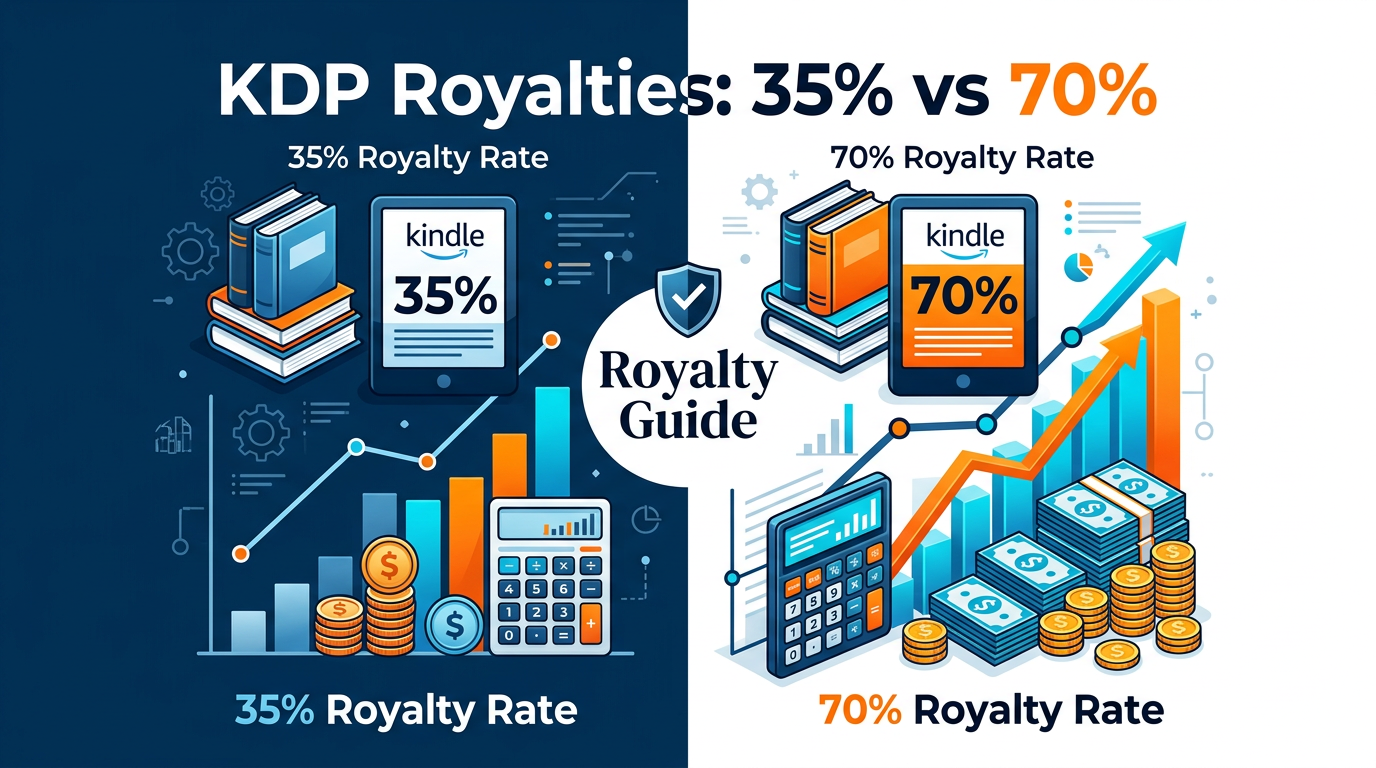
For independent authors, the decision to publish on Amazon Kindle Direct Publishing (KDP) is often the first major step toward a professional writing career. However, the excitement of seeing your book go live is often tempered by the complexity of Amazon’s payout structure. Navigating the choice between the 35% and 70% royalty rates is not merely a matter of picking the higher number; it is a strategic business decision that affects your pricing, your global reach, and ultimately, your bottom line.
In this guide, we will move far beyond the surface-level definitions. We will explore the "hidden" costs of delivery fees, the nuances of international territories, and the specific instances where the 35% rate actually puts more money in your pocket than the 70% option. Whether you are a first-time novelist or a seasoned non-fiction author, understanding these mechanics is essential for building a sustainable publishing business.
The Fundamentals of Amazon KDP Royalty Structures
Amazon KDP provides two primary royalty paths for eBooks. While the names suggest a simple percentage-based payout, the reality involves specific price brackets, file size calculations, and territorial restrictions. Before choosing, it is helpful to use a Royalty Calculator to visualize how these percentages translate into actual bank deposits.
The 70% Royalty Rate: The Premium Choice
The 70% royalty rate is the standard goal for most self-published authors. To qualify for this rate, your eBook must meet several criteria:
- Pricing Brackets: The book must be priced between $2.99 and $9.99 in most marketplaces.
- Price Parity: The eBook price must be at least 20% below the list price of the physical print edition.
- Territory Restrictions: The 70% rate only applies to sales made to customers in specific "70% territories" (such as the US, UK, Canada, Germany, and others). Sales outside these regions often default to 35% unless the book is enrolled in KDP Select.
- Delivery Fees: Unlike the 35% plan, the 70% plan requires the author to pay a small "delivery fee" for every megabyte of the file size.
The 35% Royalty Rate: The Flexible Alternative
The 35% royalty rate is often viewed as the "budget" or "fallback" option, but it serves a vital role in certain marketing strategies. It is used when:
- Low Price Points: You want to price your book between $0.99 and $2.98 to attract a high volume of new readers.
- High Price Points: You are selling a specialized technical manual or a large bundle priced above $9.99.
- Large File Sizes: Your book contains many images (cookbooks, photography guides, textbooks) where delivery fees would eat up the majority of a 70% royalty.
- Public Domain Content: Books consisting primarily of public domain material are restricted to the 35% rate.
The Hidden Profit Killer: Understanding Delivery Fees
One of the most common mistakes new authors make is ignoring the delivery fee associated with the 70% royalty rate. Amazon charges authors based on the file size of the eBook, typically $0.15 per megabyte (MB) in the US marketplace. While this sounds negligible for a text-heavy novel of 0.5 MB ($0.07 fee), it becomes a major factor for image-rich books.
Imagine you have a high-resolution cookbook that is 50 MB in size. Under the 70% royalty plan, Amazon would deduct $7.50 ($0.15 x 50) just for "delivering" the digital file to the customer. If your book is priced at $9.99, your 70% royalty would be roughly $7.00. However, after the $7.50 delivery fee, you would actually owe Amazon money—or more accurately, your royalty would be zeroed out. In this specific case, the 35% royalty plan (which has zero delivery fees) would earn you $3.50 per sale. This is a classic example of where a lower percentage yields a higher profit.
To avoid this pitfall, always check your file size in the KDP dashboard during the upload process. If your file is large, consider compressing images or switching to the 35% royalty plan. You can also use the Cover Calculator to ensure your physical dimensions are optimized, which indirectly helps in planning your digital layout.
Strategic Pricing: When to Choose 35% vs. 70%
Pricing is the most powerful lever an author has to control their sales volume and profit margins. Choosing the right royalty rate depends entirely on your current business objective.
When to Use the 70% Royalty Option
This is the "sweet spot" for 90% of fiction and standard non-fiction books. If your book is a standard novel (50,000 to 100,000 words), your file size will likely be under 1 MB. By pricing between $2.99 and $9.99, you maximize your take-home pay. For a $4.99 book, you earn roughly $3.45 per copy. On the 35% plan, that same book would only earn you $1.75.
When to Use the 35% Royalty Option
The 35% rate is a strategic tool for the following scenarios:
- The "Loss Leader" Strategy: If you are launching the first book in a long series, pricing it at $0.99 can entice thousands of readers to try your work. While the royalty is low ($0.35 per sale), the goal is to drive readers to your subsequent books, which are priced at $4.99 or higher.
- Box Sets and Bundles: If you bundle five novels together and want to charge $14.99, you must use the 35% rate. Amazon does not allow the 70% rate for eBooks priced above $9.99.
- International Markets: In countries like Brazil, Japan, Mexico, and India, you only get the 70% rate if you are enrolled in KDP Select. If you are "going wide" (publishing on Apple, Kobo, etc.), sales in these specific Amazon territories will default to 35%.
The KDP Select Factor: Exclusivity vs. Reach
KDP Select is a program that requires you to give Amazon exclusive rights to sell your eBook for 90-day increments. In exchange, you get access to Kindle Unlimited (KU) and the ability to earn 70% royalties in territories where it would otherwise be capped at 35%.
Expert Insight: For many authors, the 70% royalty isn't the main draw of KDP Select; it's the Kindle Unlimited page reads. KU allows subscribers to read your book for "free," and you are paid per page read (usually around $0.004 to $0.005 per page). For a 300-page novel, this can equal about $1.30 to $1.50 in royalty. If your audience consists of "voracious readers" (common in Romance, Thriller, and LitRPG), the 70% royalty on sales combined with KU page reads is almost always the most profitable path.
However, "Going Wide"—publishing on multiple platforms—can be better for long-term brand stability. If you are wide, you must carefully manage your pricing on Amazon to ensure you stay within the 70% brackets while staying competitive on platforms like Google Play or Barnes & Noble.
Geographic Nuances and International Royalties
Amazon is a global marketplace, but its royalty rules are not uniform. To earn 70% on a sale, the customer must usually be located in one of the following countries: United States, United Kingdom, Canada, Germany, France, Italy, Spain, Japan, Brazil, Mexico, India, Australia, and several others.
However, there is a catch. To earn 70% in Brazil, Japan, Mexico, and India, your book must be enrolled in KDP Select. If it is not enrolled, your sales in those specific countries will be paid out at 35%, even if your price is within the $2.99-$9.99 range. For authors with a significant following in India or Japan, this is a massive distinction that can change their entire distribution strategy.
When setting your prices, don't forget to use the Keyword Combiner to find niche terms that might help you rank better in these specific international stores. Tailoring your metadata to local audiences can increase the volume of these international sales, making the royalty choice even more impactful.
Print Royalties: A Different Ballgame
It is important to clarify that the 35%/70% choice applies only to eBooks. Print-on-demand (POD) royalties for paperbacks and hardcovers are calculated differently. For print books, the standard royalty is 60% of the list price, minus printing costs.
The math for print looks like this:
(Retail Price x 0.60) - Printing Costs = Your Royalty
Because printing costs depend on page count, ink type (black and white vs. color), and trim size, your actual take-home percentage on a print book is often much lower than 60% of the total retail price. For example, a $15.00 paperback that costs $5.00 to print would net you a $4.00 royalty. This is effectively a 26% royalty on the retail price. Always use a dedicated calculator to ensure your print prices are high enough to sustain a profit after Amazon takes its cut.
Common Mistakes When Managing KDP Royalties
Over the years, we have seen authors lose thousands of dollars due to simple clerical errors or a lack of understanding of the KDP terms of service. Here are the most common pitfalls to avoid:
- Setting the Price at $2.98: It sounds like a minor difference, but $2.98 falls into the 35% bracket. By increasing the price by just one cent to $2.99, your royalty jumps from $1.04 to $2.09. That one cent doubles your income.
- Ignoring Bloated File Sizes: Including "ultra-HD" images that aren't optimized for Kindle screens increases your delivery fees. Always use image compression tools before uploading.
- Price Matching Issues: If you sell your book for $0.99 on Apple Books, Amazon’s bots will likely find it and automatically lower your Amazon price to $0.99 to match. If you were on the 70% royalty plan at $3.99, Amazon will keep you on that plan but at the $0.99 price point—meaning you might earn almost nothing after delivery fees.
- Forgetting the "20% Rule": Amazon requires your eBook to be at least 20% cheaper than your print book to qualify for the 70% rate. If your paperback is $10.00 and you try to price your eBook at $9.99, you may be forced into the 35% tier.
Step-by-Step Strategy for Maximum Profit
If you are feeling overwhelmed, follow this proven roadmap to optimize your Amazon KDP earnings:
- Calculate Your "Real" Royalty: Use the KDP dashboard's "Pricing" tab to see exactly what your delivery fee will be. If it’s over $0.50, look for ways to reduce your file size.
- Choose Your Launch Price: Many authors launch at $0.99 (35% rate) for the first week to gain reviews and ranking, then switch to $3.99 or $4.99 (70% rate) once the book has momentum.
- Optimize Your Metadata: Before you even worry about royalties, you need sales. Use the HTML Description Formatter to make your book description look professional and readable. A clean, bold description increases conversion rates.
- Monitor Your International Sales: If you see a surge of sales in India or Mexico, evaluate if joining KDP Select for 90 days is worth the 70% royalty boost in those regions.
- Regularly Audit Your Prices: Inflation and market trends change. A price that worked two years ago ($2.99) might be too low today. Test higher price points ($4.99 or $5.99) to see if your sales volume stays steady; if it does, your profit per hour spent writing increases significantly.
Expert Insights: The Future of KDP Royalties
The publishing landscape is shifting. With the rise of AI-generated content and the saturation of the Kindle Store, Amazon is becoming more stringent with its quality requirements. To maintain your 70% royalty eligibility, ensure your book follows all formatting guidelines and contains no "low-content" attributes unless categorized correctly.
Furthermore, keep an eye on "Global Fund" payouts for Kindle Unlimited. As more authors join KDP Select, the per-page rate fluctuates. Diversifying your income by having some books "wide" (35%-70% depending on the store) and some in KDP Select is a common strategy for high-earning "authorpreneurs."
Conclusion: Data-Driven Publishing
Choosing between 35% and 70% is not a "set it and forget it" decision. It is a dynamic part of your marketing funnel. For most, the 70% royalty plan provides the best return on investment, but the savvy author knows that the 35% plan is a powerful tool for aggressive discounting, international expansion, and handling complex, image-heavy files.
Success on Amazon KDP requires a blend of creative talent and analytical rigor. By monitoring your delivery fees, staying within the correct pricing brackets, and utilizing professional tools like the Royalty Calculator and Keyword Combiner, you position yourself as a professional in a sea of amateurs. Treat your publishing journey as a business, and the royalties will follow.
Actionable Advice: Today, log into your KDP dashboard and review your "Pricing" tab for every live book. Check if any file sizes have ballooned or if your international pricing in currencies like the Euro or Yen has slipped out of the 70% eligibility range due to exchange rate fluctuations. A five-minute audit today could lead to a significant raise in your next monthly payout.
Be the first to leave a comment!