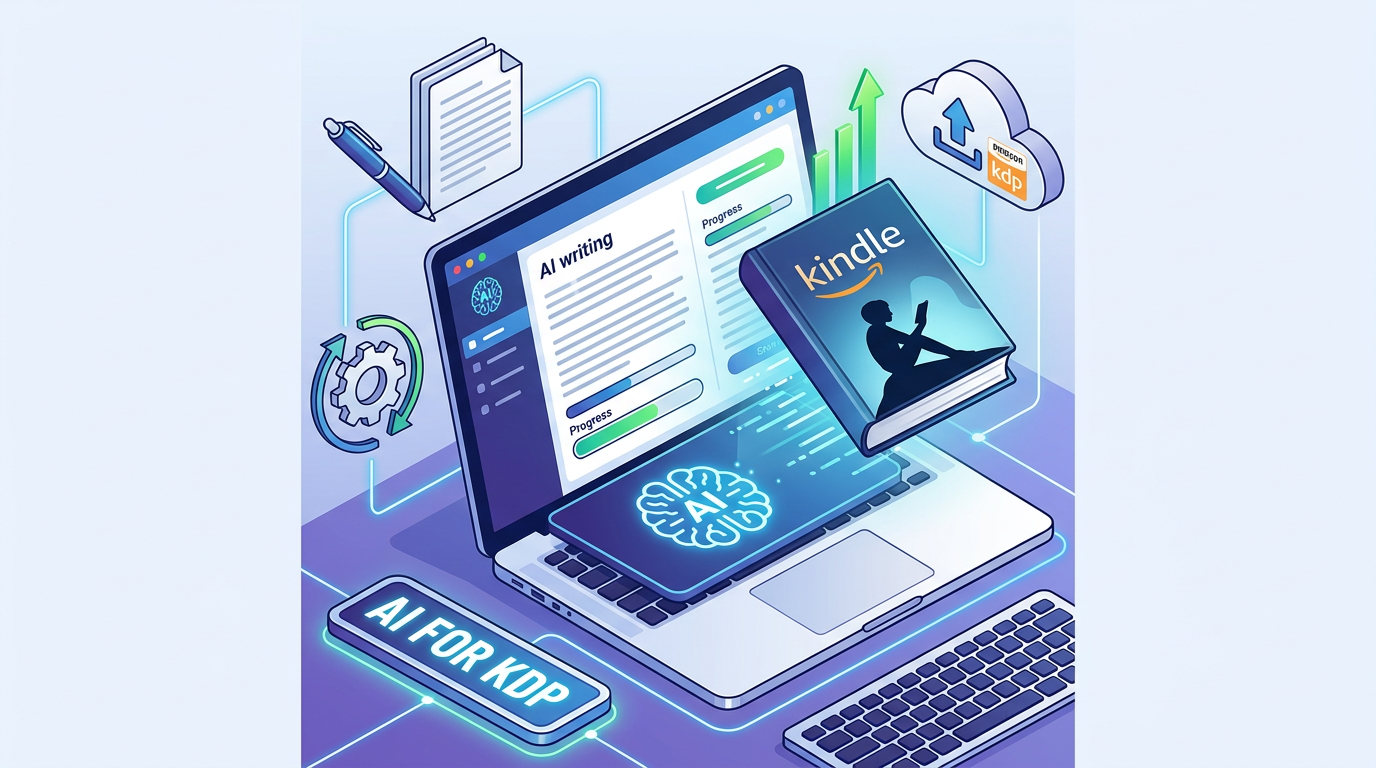
The landscape of self-publishing has undergone a seismic shift since the emergence of Large Language Models (LLMs) and generative AI. For Amazon Kindle Direct Publishing (KDP) authors, this isn't just a trend; it is a fundamental change in how books are researched, written, designed, and marketed. While the early days of AI in publishing were marked by low-quality "spam" content, the modern professional author uses AI as a sophisticated co-pilot to enhance creativity and productivity.
In this comprehensive guide, we will move beyond the generic "how-to" and dive deep into the professional methodologies required to build a sustainable, high-quality KDP business using artificial intelligence. Whether you are a fiction novelist looking to beat writer's block or a non-fiction entrepreneur aiming for the bestseller lists, understanding the nuanced application of AI is essential for success in today’s competitive marketplace.
Understanding Amazon's AI Disclosure Policy
Before diving into tools and techniques, every KDP author must understand the regulatory environment. Amazon has updated its content guidelines to include specific requirements for AI-generated and AI-assisted content. This is not just a suggestion; failing to disclose properly can lead to account termination.
AI-Generated Content: Amazon defines this as text, images, or translations created by an AI-based tool where the author did not substantially edit the output. If you prompt an AI to "write a 5,000-word book about keto diets" and publish the raw output, that is AI-generated.
AI-Assisted Content: This refers to content created by humans where AI was used for brainstorming, outlining, or minor editing. If you write the manuscript yourself but use AI to fix grammar or suggest a better way to phrase a single paragraph, you typically do not need to disclose this as "AI-generated."
Expert Insight: Always lean toward transparency. As Google’s E-E-A-T (Experience, Expertise, Authoritativeness, and Trustworthiness) guidelines become more sophisticated, human oversight remains the primary metric for quality. Your goal should be "AI-assisted, human-perfected" content.
Phase 1: Advanced Niche Research and Keyword Strategy
Most AI-generated books fail because they target overly competitive niches or lack a specific audience. The first step in a professional KDP workflow is data-driven research. While AI can brainstorm topics, it lacks real-time access to Amazon’s sales algorithms. You must bridge this gap.
Using AI for Audience Persona Development
Instead of asking an AI "What should I write about?", ask it to build a persona. For example: "Create a detailed psychographic profile of a 35-year-old woman struggling with work-life balance who is interested in Stoic philosophy." This gives you a target audience. Once you have the persona, you can identify their pain points and create a book that solves them.
The Power of Keyword Optimization
Keywords are the lifeblood of KDP visibility. You need to find the "sweet spot" where search volume is high but competition is manageable. This is where strategic tools become vital. By using a Keyword Combiner, you can merge high-intent verbs (e.g., "how to," "guide," "workbook") with your niche topics to find long-tail keywords that AI alone might miss.
Research Statistics: According to industry data, books optimized with specific, long-tail keywords (4+ words) see an average of 30% higher organic click-through rates compared to generic titles. Do not let the AI choose your final keywords; use it to generate ideas, then validate them with real market data.
Phase 2: Narrative Architecture and Structural Outlining
The biggest mistake novice authors make is asking an AI to "write the book." The result is almost always a repetitive, shallow manuscript that readers will reject. Professional authors use AI for Narrative Architecture.
Non-Fiction Structural Engineering
For non-fiction, use AI to create a comprehensive table of contents. Prompt the AI by providing it with the top 10 pain points of your target audience. Ask it to "Organize these 10 problems into a logical 12-chapter progression that moves from foundational theory to practical implementation." This ensures your book has a "transformational arc," which is what keeps readers engaged.
Fiction Plotting and World-Building
In fiction, AI is unparalleled for "rubber-ducking" (the process of talking through a problem). If you are stuck at the end of Act 2, describe your characters and the current conflict to the AI. Ask for "five unconventional plot twists that stay true to the protagonist's established motivations."
- Character Bible: Use AI to keep track of character traits, eye colors, and backstories to ensure consistency across a series.
- World Building: Ask for detailed descriptions of fictional economies, magic systems, or historical timelines to add depth to your setting.
Phase 3: High-Quality Drafting (The "Human-in-the-Loop" Method)
To produce a book that meets Google AdSense quality standards and passes Amazon’s manual reviews, you must adopt a "Human-in-the-Loop" (HITL) approach. This means the AI never writes more than a few paragraphs without human intervention.
The Modular Drafting Process
- The Prompt: Instead of "write Chapter 1," use a prompt like: "Write a 500-word introduction to the concept of neuroplasticity, using a conversational yet authoritative tone. Include a metaphor about a forest path."
- The Review: Read the output. Is it generic? Is it "fluffy"? AI often uses phrases like "In the fast-paced world of today..." or "It's important to note that..." Delete these immediately.
- The Injection: Add a personal anecdote, a specific study, or a controversial opinion. This adds the "Experience" and "Expertise" components of E-E-A-T.
- The Expansion: Ask the AI to expand on specific points you’ve added, ensuring the flow remains logical.
Avoiding the "AI Voice"
AI text is often characterized by perfect grammar but zero soul. To combat this, give the AI a "Voice Profile." Tell it to "Write in the style of a pragmatic mentor" or "Use the clipped, fast-paced syntax of a noir thriller." Better yet, feed the AI a 1,000-word sample of your own writing and ask it to analyze your style before it assists with drafting.
Phase 4: Professional Editing and Refinement
Editing is where a "good" book becomes a "great" book. AI is an incredible tool for technical editing, but it struggles with developmental editing (the big picture).
Technical Polish
Tools like Grammarly or ProWritingAid (which are built on AI) are standard. However, you can go further by using LLMs to check for tone consistency. Ask the AI: "Does the tone shift significantly between Chapter 3 and Chapter 4?" or "Identify any instances where the protagonist sounds out of character based on their established persona."
Fact-Checking and Hallucinations
Warning: AI is notorious for "hallucinations"—confidently stating false facts. If you are writing non-fiction, you must manually verify every statistic, date, and name. Use AI to find sources, but go to those sources yourself to confirm the data. Publishing a book with factual errors is the fastest way to get 1-star reviews and lose your AdSense-eligible traffic.
Phase 5: Visual Excellence—Covers and Formatting
Readers do judge a book by its cover. AI image generators like Midjourney or DALL-E 3 have democratized high-end cover art, but they require a skilled hand to produce professional results.
Creating the Cover Art
When using AI for cover art, focus on composition. A great book cover needs space for typography. Prompt your AI to create "minimalist backgrounds" or "subjects with significant negative space." Once you have the image, use a professional design tool to add the title and author name.
Crucial Step: Before finalizing your design, use the Cover Calculator to ensure your dimensions are exactly correct for your page count. Amazon’s printing presses have zero tolerance for incorrect spine widths or bleed margins.
Interior Formatting
Formatting for Kindle (Ebook) and Print (Paperback) are two different beasts. AI can help you write the CSS for a specialized ebook layout or suggest font pairings that improve readability. For non-fiction, ensure you have a "Clickable Table of Contents," which is a major ranking factor for Kindle user experience.
Phase 6: Amazon Listing Optimization (The "Sales Engine")
Your book is finished, but your work isn't. You need to "sell" the book to both the Amazon algorithm and the human reader.
The Sales Description
Your book description is your sales page. Use AI to draft a "hook-driven" description. Use the "AIDA" formula (Attention, Interest, Desire, Action). Once you have a compelling blurb, use the HTML Description Formatter to ensure the text looks beautiful on the Amazon sales page. Bold headers and bullet points are essential for converting "scanners" into "buyers."
Pricing and Royalties
Pricing strategy is often overlooked. Should you price at $2.99 or $9.99? Use the Royalty Calculator to see how different price points affect your take-home pay after Amazon’s printing costs and delivery fees. Professional authors often start with a "launch price" to gather reviews and then raise it once the book gains traction.
Common Mistakes to Avoid
"The greatest danger of AI in KDP is not that it will replace authors, but that it will lead to a flood of mediocre content that destroys reader trust." — Industry Expert Insight
To stay ahead of the curve, avoid these common pitfalls:
- The "One-Prompt" Book: Never try to generate an entire book in one go. The quality will be abysmal, and the structure will fail.
- Ignoring the "Look Inside" Feature: Amazon allows readers to preview the first 10% of your book. If this section feels like "AI filler," you will never get the sale. Spend 50% of your editing time on the first two chapters.
- Over-Reliance on AI Covers: AI struggles with text and human hands. If your cover looks "uncanny" or "weird," it will repel readers. Always do a "sanity check" with a human designer or a focus group.
- Neglecting Author Central: Your Amazon Author Central profile provides the "Authority" in E-E-A-T. Fill it out completely with a real bio and photo. AI cannot build a brand; only you can.
Expert Strategies for Long-Term Success
If you want to build a real publishing brand, you must think beyond a single book. Here are the strategies the pros use:
1. Rapid Prototyping
Use AI to test three different book concepts. Create "coming soon" landing pages or social media polls. See which topic gets the most engagement before you spend weeks writing the full manuscript.
2. The "Short-to-Long" Funnel
Use AI to generate a series of high-quality "lead magnets" (10-20 page booklets). Offer these for free in exchange for email sign-ups. Once you have a list of 1,000+ readers, your next book launch is guaranteed to hit the top of the charts.
3. Multi-Format Expansion
Once your book is successful, use AI to help translate it into other languages or to draft scripts for an audiobook version. This multiplies your income streams without requiring you to write a new book from scratch.
Conclusion: The Future of the Augmented Author
AI tools for Amazon KDP are not a "get rich quick" shortcut; they are a sophisticated suite of instruments for the modern creator. By integrating AI into a rigorous, human-led workflow, you can produce books that are more researched, better structured, and more polished than ever before.
The key to success lies in the Value Add. Ask yourself: "What am I bringing to this book that an AI couldn't?" Whether it’s your unique life experience, your specialized professional knowledge, or your creative storytelling voice, that is what will ultimately earn the trust of readers and the approval of platforms like Google and Amazon.
Start by identifying a niche with high demand, use the Keyword Combiner to find your entry point, and commit to a process of rigorous editing and professional formatting. The tools are here—it's time to write the book you’ve always wanted to publish.
Be the first to leave a comment!