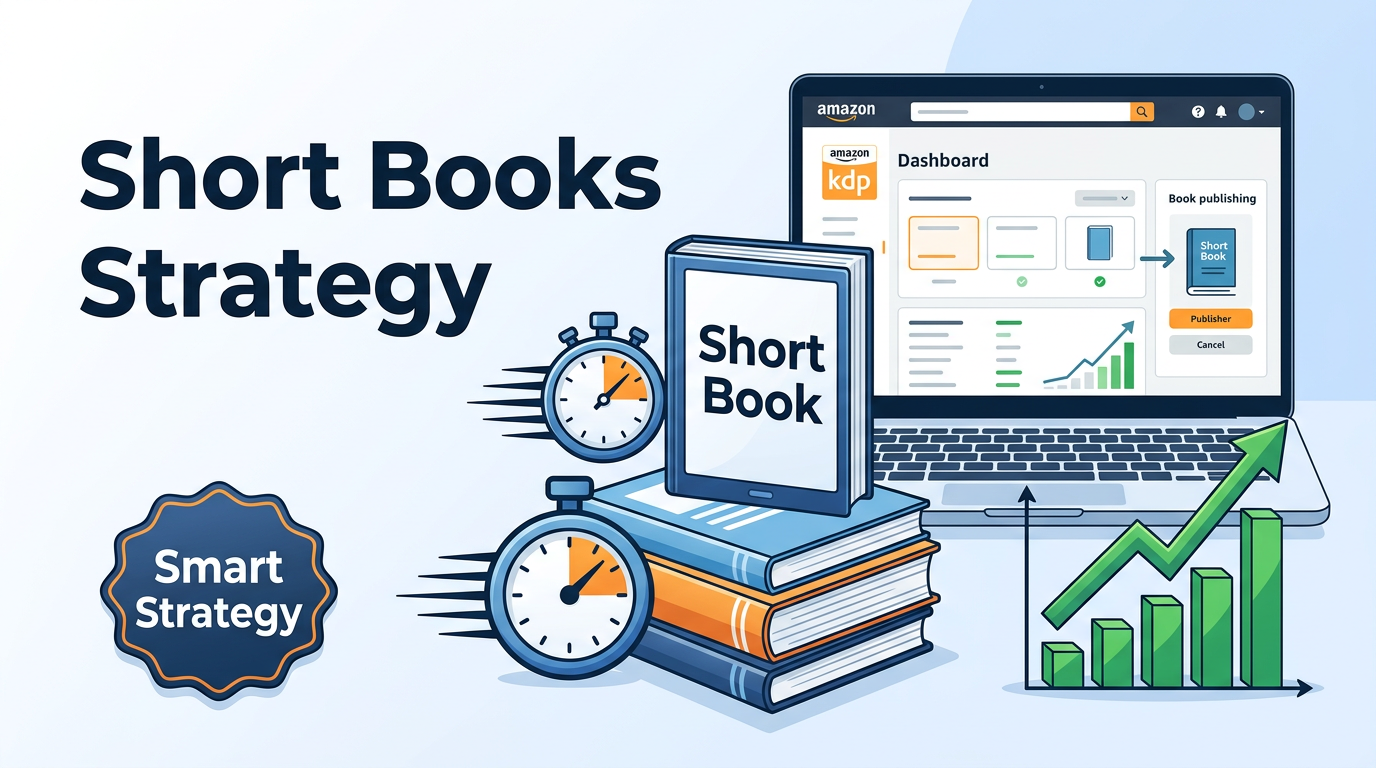
The landscape of digital publishing has shifted dramatically over the last decade. While the traditional publishing world still prioritizes the 80,000-word epic, the digital-first economy of Amazon Kindle Direct Publishing (KDP) has birthed a new, highly lucrative trend: the short-form book. Today, readers are increasingly looking for "snackable" content—information they can consume in a single sitting or a quick commute. For authors, this shift represents a massive opportunity to build an authoritative brand, test new niches, and generate a steady stream of passive income without the multi-year commitment of a traditional novel.
Writing short books—typically ranging from 10,000 to 25,000 words—is not about cutting corners or sacrificing quality. Instead, it is a strategic approach to publishing that emphasizes high-value, focused content. In this comprehensive guide, we will dive deep into why short books are the secret weapon of successful KDP entrepreneurs, how to craft them for maximum impact, and the technical strategies you need to dominate the Amazon marketplace.
Understanding the "Short Reads" Ecosystem on Amazon
Before you begin writing, it is essential to understand how Amazon views short content. Amazon has a dedicated section known as "Kindle Short Reads." These are categorized by the estimated reading time, ranging from "15 minutes (1-11 pages)" to "Two hours or more (65-100 pages)." By targeting these specific categories, you are meeting a distinct consumer demand: the reader who wants to learn a specific skill or enjoy a self-contained story during their lunch break.
In the non-fiction space, these books are often called "Single-Topic Guides." In fiction, they are usually "Novellas" or "Short Story Collections." The key to success here is specificity. A short book that tries to cover "The History of the World" will fail because it will be too shallow. However, a short book titled "7 Days to Master Sourdough Starters" provides immediate, concentrated value, which is exactly what Kindle Short Read customers are looking for.
The Strategic Advantages of the "Micro-Publishing" Model
Why should an author choose to write three 20,000-word books instead of one 60,000-word book? The answer lies in the mathematics of the Amazon algorithm and the psychology of the modern consumer.
- Increased Digital Real Estate: Every book you publish is a new entry point into your ecosystem. Three books mean three sets of keywords, three different categories, and three opportunities to appear in the "Customers who bought this also bought" carousels.
- Rapid Feedback Loops: You can test a niche with a 12,000-word book and see if it gains traction. If it does, you can expand it or turn it into a series. If it doesn't, you haven't wasted six months of your life on a project that won't sell.
- Higher Read-Through Rates: For authors writing series, short books are easier for readers to finish. This leads to a higher "read-through" rate, which is a critical metric for the Amazon algorithm. When readers finish Book 1 quickly, they are much more likely to immediately purchase Book 2.
- The "Halo Effect": A new release often boosts the sales of your older titles. By publishing more frequently (which is easier with shorter books), you keep your entire catalog "warm" in the eyes of the algorithm.
Phase 1: Market Research and Niche Validation
The most common mistake beginners make is writing a book based on a "gut feeling" rather than data. To succeed with short books, you must identify "starving crowds"—groups of readers looking for specific information that isn't being adequately provided by the current market.
Start by looking at the best-seller lists in narrow sub-categories. Use tools like the Keyword Combiner to generate a list of potential search terms that readers might use. You are looking for high-demand, low-competition keywords. For example, instead of targeting "Weight Loss," look for "Keto for Women Over 50" or "Intermittent Fasting for Busy Nurses."
The "Problem-Solution" Framework
For non-fiction, the most successful short books follow a simple framework: Identify a single, painful problem and provide a clear, actionable solution. If your book can solve that problem in 15,000 words, your readers will thank you for not wasting their time with filler content. In fact, modern readers often prefer a 50-page book that solves their problem over a 300-page book that contains 250 pages of fluff.
Phase 2: Writing for Clarity and Speed
Writing a short book requires a different mental approach than a full-length manuscript. You must be ruthless with your editing and focused with your prose. Here is an expert-level workflow for producing high-quality short books efficiently:
1. The Skeleton Outline
Never start with a blank page. Create a detailed outline where every chapter serves a specific purpose. For a 15,000-word book, you might have 10 chapters of 1,500 words each. This makes the writing process feel manageable. Each chapter should follow a structure: The Hook, The Information, The Case Study/Example, and The Summary.
2. Eliminating Subplots and Tangents
If you are writing fiction, stick to a single point of view (POV) and a linear timeline. Subplots are the enemy of the novella; they add word count without necessarily adding value to the core emotional arc. For non-fiction, avoid long-winded personal anecdotes unless they directly illustrate a point. Keep the focus on the reader's journey, not yours.
3. Using Authority Signals
Even in a short book, you must establish E-E-A-T (Experience, Expertise, Authoritativeness, and Trustworthiness). Cite recent studies, mention current industry trends, and provide "pro-tips" that only someone with actual experience would know. This prevents your book from feeling like a "content farm" product and makes it a legitimate resource.
Phase 3: Mastering the Technical Requirements
The technical aspects of KDP can make or break your success. Because your book is shorter, your margins for error are thinner. You need every element of your metadata to be perfect.
Formatting for Conversion
Your book description is your sales page. Many authors neglect this, but a well-formatted description can double your conversion rate. Don't settle for plain text; use the HTML Description Formatter to add bold headers, bullet points, and clear calls to action. A professional-looking description signals to the reader that the content inside is also professional.
Cover Design and Spine Considerations
If you plan on offering a paperback version of your short book (which you should, as it adds perceived value), you must be aware of physical constraints. A book must usually have at least 72 to 100 pages to have text on the spine. If your book is very short, you may need to adjust your formatting—such as increasing font size or line spacing slightly—to meet these requirements. Use the Cover Calculator to get the exact dimensions for your wrap-around cover based on your final page count. This ensures your professional design doesn't get cut off during the printing process.
The Royalty Math: 35% vs 70%
One of the nuances of short books is pricing strategy. Amazon offers two royalty tiers: 35% and 70%. To qualify for the 70% royalty, your book must be priced between $2.99 and $9.99. If you price your short book at $0.99 (a common strategy for "leads" or very short reads), you will only receive 35%.
You need to decide on your goal. Is the book a "lead magnet" to get people into your email list? Then $0.99 is great. Is it a standalone profit center? Then you should aim for a word count that justifies a $2.99 price point. You can use the Royalty Calculator to run the numbers and see how many copies you need to sell at different price points to hit your income goals. Often, you will find that selling fewer copies at $2.99 is more profitable than high volume at $0.99.
Common Pitfalls in Short Book Publishing
While the short book strategy is powerful, it is often abused. To maintain a high-quality "AdSense-ready" or "E-E-A-T friendly" brand, avoid these common mistakes:
"The biggest mistake I see in the KDP space is authors thinking 'short' means 'low quality.' Amazon is quick to flag and remove 'thin content.' If your book feels like a collection of Wikipedia articles, your account will eventually be at risk." — Industry Insight from a Top 100 KDP Publisher.
- Over-Promising and Under-Delivering: If your title says "The Complete Guide" but the book is only 10 pages, you will get 1-star reviews. Be honest about the scope.
- Poor Formatting: Short books are often read on mobile devices. Ensure your Kindle file is reflowable and that your images (if any) are high-resolution.
- Neglecting the "Front and Back Matter": Use the beginning of your book to offer a free gift (a checklist or template) in exchange for an email sign-up. Use the end of the book to ask for a review and link to your next book.
- Generic AI Content: Readers can spot unedited AI content from a mile away. Use AI to help outline or brainstorm, but the final prose should have a human voice and unique insights.
Advanced Marketing for Short Books
Once your book is live, the work has just begun. Because short books are often part of a larger strategy, your marketing should be interconnected.
The Series "Snack" Strategy
If you have a 3-book series, make the first book a 10,000-word "Introduction" or "Prequel" and price it at $0.99. This lowers the barrier to entry. Once the reader is hooked on your style and expertise, they will be much more likely to pay $4.99 or $9.99 for your more comprehensive follow-up works.
Leveraging Amazon Advertising (AMS)
Short books can be very profitable on Amazon Ads if you target "Long-Tail Keywords." Instead of bidding on "Self-Help," bid on the specific problem your book solves. Since your book is focused, your "Relevancy Score" in the Amazon ad auction will be higher, often leading to lower costs-per-click (CPC).
Final Strategic Advice for Aspiring Publishers
Success on Amazon KDP is a marathon, not a sprint—even when you are writing "short" books. The goal is to build a catalog of assets that work for you 24/7. Focus on creating a "Minimum Viable Product" (MVP) that provides genuine value, then iterate based on customer reviews.
As you build your library, remember that data is your best friend. Monitor your "Kenp Read" (Kindle Edition Normalized Pages) if you are in the KDP Select program. This tells you exactly how many pages people are reading. If readers are dropping off at Chapter 3, go back and look at that chapter—is it boring? Is it too technical? This level of analysis is what separates the hobbyists from the professional publishers.
By combining the efficiency of short-form content with a deep commitment to quality and SEO optimization, you can build a publishing empire that stands the test of time and satisfies both the Amazon algorithm and your human readers.
Actionable Checklist for Your First Short Book:
- Validate your niche using the Keyword Combiner.
- Outline 10-12 chapters focusing on a single, specific problem.
- Write 15,000–20,000 words of high-value, fluff-free content.
- Use the Cover Calculator to design a professional paperback and ebook cover.
- Format your Amazon sales page using the HTML Description Formatter.
- Price strategically using data from the Royalty Calculator.
- Publish and immediately begin gathering feedback for your next title.
Be the first to leave a comment!