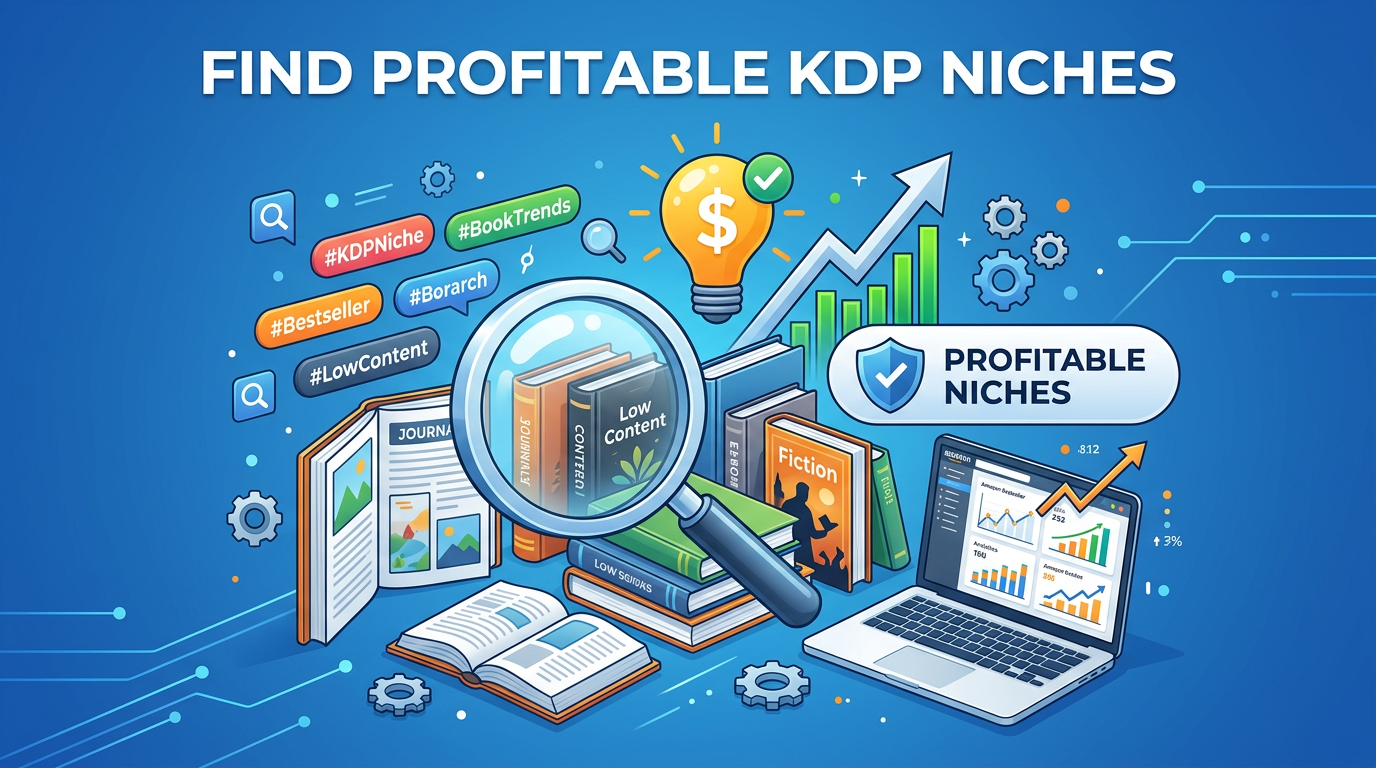
The landscape of Amazon Kindle Direct Publishing (KDP) has shifted dramatically over the last few years. Gone are the days when an author could simply upload a generic "Notebook" or a hastily written guide on "How to Lose Weight" and expect to see royalties rolling in. Today, the marketplace is more sophisticated, more competitive, and more data-driven than ever before. Success in 2024 and beyond is not about writing more books; it is about writing the right books for the right audience.
Finding a profitable niche is the foundation of a successful self-publishing business. Whether you are focused on high-content books like non-fiction and novels, or low-content products like journals and planners, your ability to identify underserved markets will determine your return on investment (ROI). In this comprehensive guide, we will move beyond generic advice and dive deep into the mechanics of niche validation, keyword analysis, and the psychological triggers that turn casual browsers into loyal readers.
Understanding the KDP Niche Ecosystem
A niche is often misunderstood as a broad category. For example, "Self-Help" is not a niche; it is a massive industry. "Mindfulness for High-Stressed ER Nurses" is a niche. The goal of niche research is to find a segment of the market that has enough demand to be profitable but not so much competition that your book is buried on page 20 of the search results.
Expert publishers use a "Top-Down" and "Bottom-Up" approach to research. A top-down approach involves looking at broad trends (e.g., the rise in homesteading) and drilling down into specific sub-topics. A bottom-up approach involves starting with specific keywords and seeing if there is a viable market around them. To succeed, you must balance these two methods while keeping a close eye on Amazon’s Best Sellers Rank (BSR).
The Golden Ratio of Niche Selection
When evaluating a potential market, professional publishers look for a specific set of criteria often called the "Golden Ratio." This involves finding a balance between three key metrics:
- Demand: Are people actually searching for this? Look for at least 3-5 books in the top search results with a BSR (Best Sellers Rank) under 100,000.
- Competition: How many results appear when you type the keyword? Ideally, you want to see fewer than 2,000 search results, though higher-volume niches can be entered if the existing books are of poor quality.
- Commercial Intent: Are people willing to pay for this information? Some niches have high traffic but low sales because the information is readily available for free online.
The Step-by-Step Niche Research Process
Successful niche research is a repeatable process. It requires patience and a willingness to follow the data rather than your personal interests. Here is the framework used by six-figure KDP publishers to validate their ideas before they ever write a single word.
Step 1: The Incognito Search Bar Method
Start by opening a private or "Incognito" browser window. This prevents Amazon’s algorithm from showing you personalized recommendations based on your past browsing history. Go to Amazon.com and set the search department to "Books" or "Kindle Store."
Use the "ABC Method." Type your main seed keyword (e.g., "Gardening") followed by the letter "a," then "b," then "c." Amazon’s auto-suggest feature will show you exactly what real customers are typing into the search bar. This is the most direct way to find long-tail keywords—specific phrases like "Gardening for seniors with limited mobility" or "Gardening in small apartment balconies."
Step 2: Analyzing the Best Sellers Rank (BSR)
The BSR is the most honest piece of data Amazon provides. It tells you how well a book is selling relative to every other book in the store. A BSR of 1 means it is the top-selling book on all of Amazon. A BSR of 1,000,000 means it sells perhaps one copy a month.
To estimate if a niche is profitable, look at the top 10 books on the first page of search results. If most of them have a BSR between 10,000 and 100,000, you have found a healthy market. If all of them have a BSR over 300,000, there is likely not enough demand to sustain a full-time income. You can use our Royalty Calculator to see how these rankings translate into actual take-home pay after Amazon takes its cut.
Step 3: Keyword Validation and Combination
Once you have a list of potential keywords, you need to understand which combinations are most effective for your metadata. Amazon gives you 7 backend keyword slots. Do not waste these by repeating words. Instead, use a tool like the Keyword Combiner to create unique, high-traffic phrases that cover as much ground as possible.
For example, instead of using "Journal" and "Diary" separately, you might combine them with specific descriptors to target multiple audiences at once. This maximizes your visibility without violating Amazon’s spam policies.
High-Content vs. Low-Content Niches: Choosing Your Path
Your strategy will differ significantly depending on whether you are producing "High-Content" (novels, memoirs, non-fiction guides) or "Low-Content" (planners, logbooks, coloring books) material.
High-Content Strategy
In high-content publishing, authority is everything. Readers are looking for solutions to problems or deep entertainment. The most profitable non-fiction niches often fall into the "Evergreen" categories: Wealth, Health, and Relationships. However, the key is to find a unique "angle." Instead of a general book on "Investing," look into "Dividend Investing for Gen Z" or "Crypto Tax Strategies for Small Business Owners."
Low-Content Strategy
Low-content publishing is driven by aesthetics and specific utility. A "Gratitude Journal" is too broad. However, a "5-Minute Gratitude Journal for Military Spouses" is a specific product that solves a specific need for a specific group of people. In this niche, the interior design and the cover are your primary selling points. You must ensure your dimensions are perfect; using a Cover Calculator is essential here to ensure your spine and bleed are accurate, preventing your book from being rejected by the KDP review team.
Advanced Strategy: The "Blue Ocean" Move
Most KDP authors focus on "Red Oceans"—markets where everyone is fighting for the same customers (e.g., "Weight Loss for Women"). A "Blue Ocean" strategy involves creating a new market or finding a sub-niche so specific that you have no immediate competition.
How do you find a Blue Ocean? Look at the 1-star and 2-star reviews of the best-selling books in a broad niche. What are the customers complaining about? Are they saying the book was too complicated? Was it missing a specific checklist? Did it lack a version for beginners? Those complaints are your roadmap. If you create a book that solves the problems the market leaders are ignoring, you can quickly capture their dissatisfied customers.
Optimizing Your Listing for Conversion
Finding the niche is only half the battle. Once the customer finds your book, you must convince them to click "Buy Now." This is where many authors fail by having a poorly formatted description or a generic cover.
The Power of HTML Descriptions
Amazon allows limited HTML in book descriptions. A giant wall of plain text is a conversion killer. By using bold headings, bullet points, and strategic formatting, you can lead the reader’s eye through your sales pitch. Using an HTML Description Formatter ensures your description looks professional and stays within Amazon’s technical guidelines. A well-formatted description increases the perceived value of your book, allowing you to potentially charge a higher price.
A+ Content and Social Proof
Amazon now allows all KDP authors to use A+ Content—the "From the Manufacturer" section on the product page. Use this space to show "inside the book" previews, author bios, and comparison charts. This builds trust (E-E-A-T) and significantly boosts conversion rates in competitive niches.
Common Pitfalls in KDP Niche Research
Even experienced publishers fall into traps that can waste months of work. Avoid these common mistakes:
- Chasing "Get Rich Quick" Trends: Beware of niches that explode overnight due to a viral social media trend (e.g., specific AI-generated puzzles). These often become oversaturated within weeks, and Amazon may crack down on low-quality content in these areas.
- Ignoring Intellectual Property: Never enter a niche that relies on trademarked terms (e.g., "Disney Coloring Book" or "Crossfit Journal"). Amazon is aggressive about terminating accounts that infringe on trademarks.
- Over-Reliance on Software: While tools are helpful, they are not a substitute for manual research. Always verify software data by looking at the actual Amazon search results.
- Underestimating Ad Costs: In high-competition niches, you may need to run Amazon Ads. If the average "Cost Per Click" (CPC) is $1.50 and your royalty is only $2.00, the niche is not sustainable unless you have a high conversion rate.
Expert Insights: The Future of KDP Niche Selection
"The future of KDP is not in volume; it is in brand building. Authors who succeed today are those who treat their niche like a business, building a mailing list and a suite of related books that keep customers coming back." — Industry Analyst
One of the most important shifts we are seeing is the move toward "Series Publishing." Instead of one-off books in different niches, successful authors are "owning" a niche by publishing 5-10 related titles. This creates a "halo effect" where a customer who buys your book on "Vegetarian Meal Prep" is highly likely to buy your follow-up book on "Vegetarian Slow Cooker Recipes." This strategy lowers your customer acquisition cost and builds long-term authority.
Key Metrics to Track for Long-Term Success
Once your book is live in your chosen niche, you must monitor its performance data to stay ahead of competitors. Don't just look at sales; look at the health of the niche as a whole.
- Click-Through Rate (CTR): If your book is appearing in searches but no one is clicking, your cover or title is likely the problem.
- Conversion Rate (CR): If people are clicking but not buying, your description or price is likely the issue. Check your formatting with the HTML Description Formatter.
- Review Velocity: How fast are you getting reviews compared to the top 5 books in the niche? Organic, honest reviews are the currency of Amazon.
- Search Term Ranking: Track which keywords are moving you to page 1. Use the Keyword Combiner to adjust your backend keywords if your initial choices aren't performing.
Conclusion: Your Path to KDP Success
Finding a profitable niche for Amazon KDP is a blend of data science and creative intuition. It requires you to look beyond what you want to write and focus on what the market is starving to read. By using the tools at your disposal—from the search bar's auto-suggest to specialized tools like the Royalty Calculator—you can significantly de-risk your publishing journey.
Remember that the best niche is one where you can provide unique value. Whether that value comes through better design, more updated information, or a more engaging writing style, your goal is to be the best option for the customer’s specific search query. Success on Amazon KDP is a marathon, not a sprint. Start with deep research, validate your ideas with hard data, and consistently provide quality to your readers. If you follow this disciplined approach, the royalties will follow.
Actionable Next Steps:
- Identify 3 "Seed Keywords" in a broad area you understand.
- Use the Incognito Search method to find 10 long-tail variations.
- Check the BSR of the top 5 books for each variation to ensure demand exists.
- Use the Cover Calculator to plan your physical book dimensions for professional results.
- Draft your description and use the HTML Description Formatter to ensure it stands out to potential buyers.

Be the first to leave a comment!