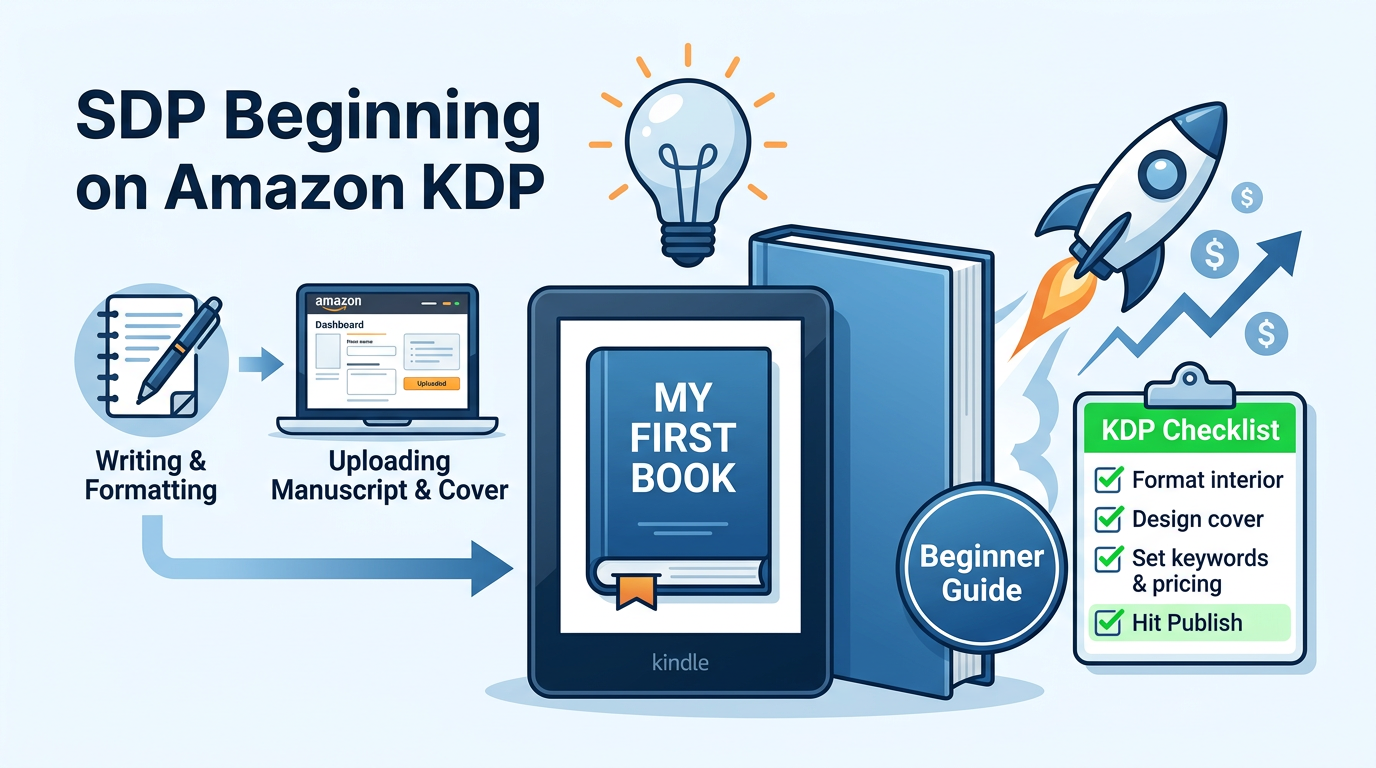
The landscape of the publishing industry has undergone a seismic shift over the last decade. Gone are the days when a handful of "Big Five" publishing houses acted as the sole gatekeepers of literature. Today, Amazon Kindle Direct Publishing (KDP) has democratized the world of books, allowing anyone with a story, a skill, or a unique perspective to reach a global audience of millions. However, with this ease of access comes a saturated market. To succeed in the modern KDP ecosystem, you cannot simply upload a Word document and hope for the best. You need a data-driven strategy, professional-grade production, and an understanding of the Amazon A9 algorithm.
This guide serves as a deep dive into the world of Amazon KDP. Whether you are a novelist looking to launch a fiction career, a business professional wanting to establish authority, or a low-content creator building a passive income stream, the following sections will provide the roadmap you need to transition from a "hopeful writer" to a "successful publisher." We will explore everything from advanced niche research to the technical nuances of royalty structures and global distribution.
The Evolution of Self-Publishing: Why Amazon KDP?
Self-publishing was once viewed as a "vanity" pursuit—a path for those who couldn't make it in traditional publishing. That stigma is dead. In the current market, indie authors often outperform traditionally published authors in terms of take-home pay and creative control. Amazon KDP controls over 80% of the ebook market in the United States, making it the most powerful tool in an author's arsenal.
The primary advantage of KDP is its "Print on Demand" (POD) technology and its seamless Kindle integration. Authors no longer need to invest thousands of dollars in inventory. When a customer orders a paperback, Amazon prints it, ships it, and takes their cut, leaving the author with a royalty. This low-barrier entry is revolutionary, but it requires a sophisticated approach to stand out among the thousands of books published every single day.
Phase 1: Strategic Market Research and Niche Selection
One of the most common mistakes beginners make is writing a book first and looking for an audience later. In the world of professional self-publishing, the process is reversed. You must identify a hungry market and then create a product that satisfies that hunger. This is where high-level SEO and market analysis come into play.
Finding the "Sweet Spot"
A profitable niche is one where there is high demand but manageable competition. You can determine demand by looking at the Best Sellers Rank (BSR) of books currently in a category. If the top 10 books in a niche all have a BSR under 50,000, you know people are buying. However, if those books all have 10,000+ reviews, the competition might be too stiff for a newcomer.
Advanced Keyword Strategy
Your keywords are the "hooks" that the Amazon search engine uses to find your book. You are allowed seven backend keyword slots, but these shouldn't just be single words. They should be long-tail phrases that reflect actual customer search intent. For example, instead of just "fitness," use "weight loss for women over 50." To streamline this process and ensure you are covering all possible search angles, authors often use a Keyword Combiner to generate exhaustive lists of potential search terms that can be tested in Amazon Advertising (AMS) campaigns.
Phase 2: Crafting Authoritative Content and Editing
Quality is the ultimate survival metric on Amazon. The "Look Inside" feature allows readers to sample the first 10% of your book. If your writing is riddled with typos or lacks a compelling hook, you will lose the sale instantly. This is the E-E-A-T principle in action: Experience, Expertise, Authoritativeness, and Trustworthiness.
The Importance of Professional Editing
Never self-edit. As the author, your brain will naturally skip over errors because it knows what it *meant* to write. There are three levels of editing you should consider:
- Developmental Editing: Focuses on the big picture—pacing, character arcs, and structural integrity.
- Copyediting: Focuses on the technicalities—grammar, syntax, and style consistency.
- Proofreading: The final pass to catch lingering typos or punctuation errors.
If you are on a budget, at the very least, use premium AI-driven tools, followed by a human proofreader. A single one-star review complaining about typos can kill a book's momentum forever.
Phase 3: Technical Formatting and Interior Design
A book that looks "self-published" is a book that doesn't sell. Proper formatting ensures that your ebook looks great on every device—from an iPhone to a Kindle Paperwhite—and that your paperback meets the physical requirements for printing. This is where many authors get frustrated, but it is a critical hurdle to overcome.
Ebook vs. Paperback Formatting
Ebooks use "reflowable" text, meaning the reader can change the font size and style. Consequently, your layout must be simple and clean. Paperbacks, however, use "fixed" layouts. You must account for trim size, bleed, and the "gutter" (the margin where the pages are glued to the spine). If your gutter is too small, your text will disappear into the binding, leading to a poor user experience and negative reviews.
For your book description on the Amazon sales page, do not settle for plain text. Use a HTML Description Formatter to include bold headers, bullet points, and emphasized text. A well-formatted description acts as a sales landing page, significantly increasing your conversion rate.
Phase 4: Cover Design and Visual Marketing
The old adage "don't judge a book by its cover" is completely false in the world of Amazon KDP. Readers judge your book by its cover in less than a second as they scroll through search results. Your cover has one job: to stop the scroll.
Psychology of a Bestselling Cover
Every genre has its own "visual language." Thrillers often use dark colors and high-contrast, sans-serif fonts. Romance novels often feature specific color palettes like pinks or deep blues with script fonts. If your cover deviates too far from these genre expectations, readers will subconsciously dismiss it because it doesn't "feel" right for the category.
For paperback authors, the technical specs of the cover are even more demanding. You must calculate the spine width based on your exact page count and paper type (white vs. cream). A mismatch here will result in a shifted cover that looks unprofessional. Use a Cover Calculator to get the exact dimensions before you or your designer start the creative process.
Phase 5: Understanding the Amazon KDP Royalty Structure
One of the most attractive parts of KDP is the royalty potential, but it can be confusing for beginners. Amazon offers two primary royalty tiers for ebooks: 35% and 70%.
The 70% Royalty Tier
To qualify for the 70% royalty, your book must be priced between $2.99 and $9.99. Additionally, the price must be at least 20% below the list price of any physical version. Note that Amazon deducts a small "delivery fee" based on the file size of your ebook in this tier (usually $0.15 per MB), so optimizing your image sizes is crucial for maximizing profit.
The 35% Royalty Tier
If your book is priced below $2.99 or above $9.99, you fall into the 35% tier. This is common for short stories or massive "box sets." For paperbacks, the royalty is a flat 60% of the list price, minus the printing costs. To accurately forecast your business expenses and set a competitive price, it is highly recommended to use a Royalty Calculator. This allows you to see exactly how much you will take home after Amazon’s cut and printing fees.
Phase 6: Publishing and Metadata Optimization
Once your files are ready, the upload process begins. This is where you finalize your "metadata"—the data about your data. This includes your title, subtitle, series information, and description.
"Your title and subtitle are the most important SEO real estate on your entire Amazon page. Include your primary keywords here, but ensure they read naturally for a human audience."
Amazon's A9 algorithm indexes these fields. If you are writing a Mediterranean cookbook, your subtitle might be "100 Easy Recipes for Heart-Healthy Living," ensuring you index for "Mediterranean cookbook," "easy recipes," and "heart-healthy."
Phase 7: Marketing and Scaling Your Author Brand
Publishing is only 20% of the work; the remaining 80% is marketing. Without traffic, your book will sit at the bottom of the rankings where no one can find it. There are two ways to drive traffic: Organic and Paid.
Organic Marketing (KDP Select)
When you enroll in KDP Select, you give Amazon exclusive rights to sell your ebook for 90 days. In exchange, your book is included in Kindle Unlimited (KU), where subscribers can read it for free, and you get paid per page read. This is a massive driver of "rank" because every page read counts toward your BSR. It also allows you to run "Free Book Promotions" or "Kindle Countdown Deals."
Paid Marketing (Amazon Advertising)
Amazon Ads (AMS) allow you to bid on keywords or specific competitor books. When someone searches for a keyword you've bid on, your book appears as a "Sponsored Product." This is the fastest way to "force" the algorithm to see that your book converts, which eventually helps your organic ranking.
Common Mistakes to Avoid
In our experience analyzing thousands of KDP accounts, these are the pitfalls that lead to failure:
- Ignoring the "Look Inside" Quality: If your first chapter is boring or unedited, no amount of advertising will save your sales.
- Poor Category Selection: Choosing categories that are too broad (like "Non-fiction") makes it impossible to climb the charts. Be specific.
- Misunderstanding Copyright: Using AI-generated images without checking the license or using trademarked terms (like "Disney" or "LEGO") in your keywords will lead to an immediate account ban.
- Neglecting Reviews: You need a "launch team" of readers ready to leave honest reviews in the first week. A book with zero reviews rarely converts at a profitable rate.
Expert Insights: The Future of KDP and AI
The rise of Generative AI (like ChatGPT) has flooded the KDP market with low-quality content. Amazon has responded by requiring authors to disclose if their content is AI-generated. The "insider" trend for 2024 and beyond is a return to "Human-Plus" content. Use AI for brainstorming, outlining, or checking grammar, but ensure the "soul" of the book—the unique insights and personal voice—is human. Readers are becoming increasingly adept at spotting "robotic" prose, and they will punish it with one-star reviews.
Furthermore, "Wide" publishing (selling on Apple Books, Kobo, and Google Play) is becoming more popular for established authors who want to reduce their dependence on the Amazon ecosystem. However, for beginners, the "KDP Select" (Amazon-exclusive) route remains the most effective way to gain initial traction.
Actionable Steps for Your KDP Journey
- Validate your idea: Check the BSR of the top 10 books in your intended niche.
- Master your metadata: Use the Keyword Combiner to build a robust keyword list.
- Invest in the exterior: Use a professional designer and verify dimensions with a Cover Calculator.
- Optimize the sales page: Use the HTML Description Formatter to make your blurb pop.
- Price for profit: Run the numbers through a Royalty Calculator to ensure your margins are sustainable.
- Launch with momentum: Run Amazon Ads immediately to signal to the algorithm that your book is relevant.
Conclusion: The Path to Publishing Authority
Success on Amazon KDP is not a matter of luck; it is a matter of discipline and data. By treating your book as a product and yourself as a publisher, you move beyond the "starving artist" trope and into the realm of professional authorship. The tools are at your fingertips, the audience is waiting, and the platform is ready. Focus on providing genuine value to your readers, optimize your technical setup, and stay consistent with your marketing. The difference between a book that gathers dust and a book that generates monthly royalties is simply the quality of the strategy behind it. Start your journey today, and build the literary legacy you've always envisioned.
Be the first to leave a comment!