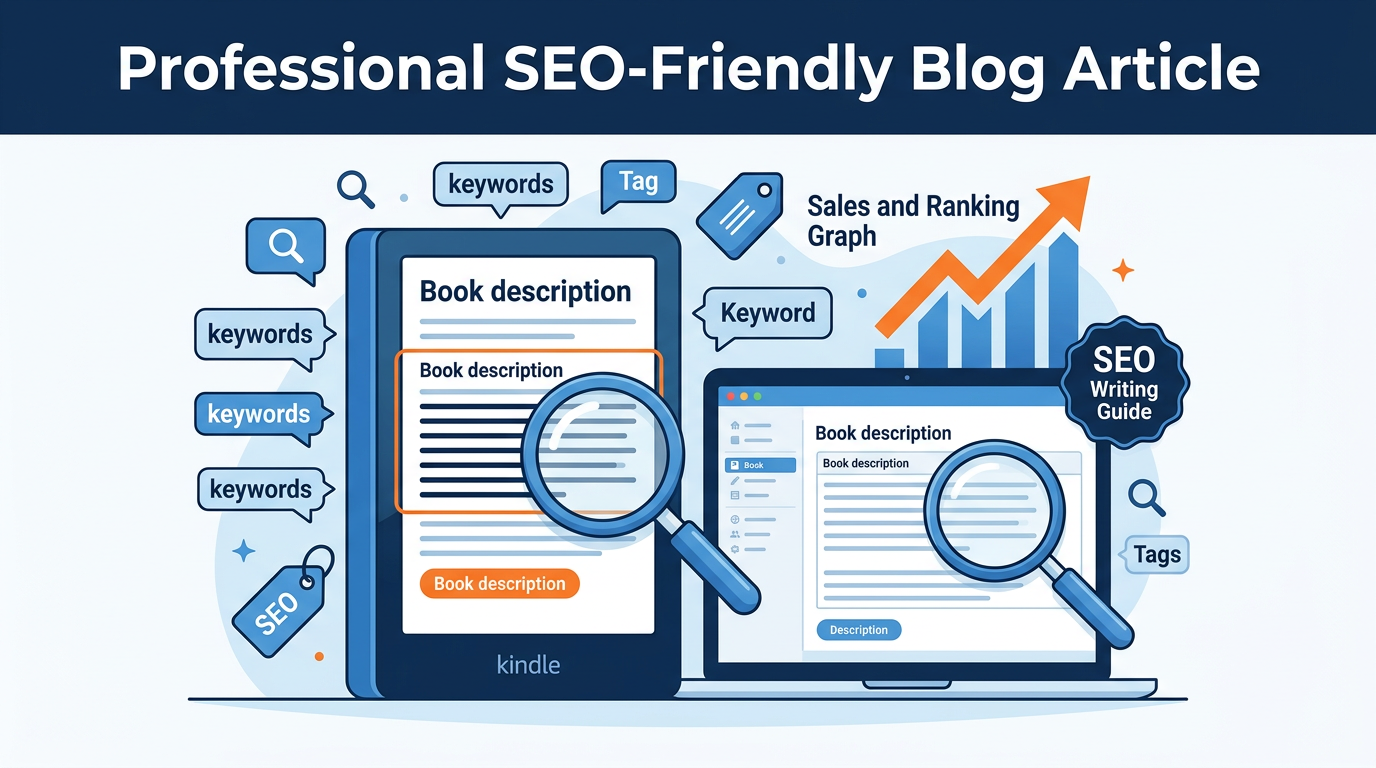
In the highly competitive ecosystem of Amazon Publishing, your book description is far more than a simple summary of your plot or table of contents. It is your ultimate sales pitch, your 24/7 digital representative, and a critical component of your Amazon Search Engine Optimization (SEO) strategy. Every year, thousands of high-quality books go unnoticed simply because their descriptions fail to bridge the gap between "being found" and "being bought."
To succeed as a self-published author or a small press, you must understand that Amazon functions as a search engine, not just a retail store. The algorithms—collectively known as the A9 and A10 algorithms—rely on specific metadata and textual signals to determine where your book ranks in search results. However, once a reader clicks on your cover, the algorithm steps aside, and copywriting takes the lead. This guide provides an exhaustive deep dive into the dual art of writing for both the Amazon algorithm and the human psyche.
The Psychology of the Sale: Why Most Descriptions Fail
Most authors approach their book description from the perspective of a creator. They want to share every nuance of their world-building or every detail of their research. This is the first and most common mistake. A potential reader is not looking for a summary; they are looking for an experience or a solution.
From a psychological standpoint, a reader scanning Amazon is in a state of "passive browsing" or "active searching." If they are browsing, they need to be emotionally hooked within the first two sentences. If they are searching, they need to see immediate proof that your book answers their specific query. When a description is a dry, chronological list of events, it fails to trigger the emotional "buy" response. To improve conversion rates, you must shift your mindset from "What is my book about?" to "What does my book do for the reader?"
Keyword Research: The Foundation of Discoverability
Before you type a single word of your description, you must understand the language your audience uses. Keyword research is the process of identifying the specific terms and phrases readers type into the Amazon search bar. These aren't just single words like "romance" or "business"; they are long-tail phrases such as "enemies to lovers fantasy romance" or "passive income strategies for beginners."
Strategic keyword placement within your description helps Amazon’s indexing bots categorize your book correctly. While Amazon places significant weight on your title, subtitle, and the seven backend keyword slots, the description provides additional context that helps the algorithm understand the nuances of your niche. For example, using the Keyword Combiner tool can help you merge primary topics with high-intent modifiers to find the "sweet spot" of low competition and high search volume.
Integrating Keywords Naturally
One of the biggest pitfalls in SEO is "keyword stuffing"—the practice of cramming as many search terms as possible into the text. Not only does this look unprofessional to readers, but modern algorithms are sophisticated enough to penalize content that feels unnatural. Instead, weave your keywords into the narrative flow of your description. If you are writing a cozy mystery, phrases like "amateur sleuth," "small-town murder," and "quirky cast of characters" should appear naturally as part of the story's setup.
The Anatomy of a High-Converting Book Description
A professional book description follows a specific structural formula designed to move the reader from curiosity to purchase. While the content changes based on genre, the skeletal structure remains remarkably consistent across top-selling titles.
1. The Hook (The Headline)
The first 150 characters are the most important part of your description. This is the text that appears before the "Read More" or "See More" fold on Amazon. Your hook must be bold, punchy, and impossible to ignore. In fiction, this might be a high-stakes question or a dramatic statement of the protagonist's conflict. In non-fiction, it is usually a bold promise of a transformation or a shocking statistic.
2. The Sizzle (The Setup)
Following the hook, you need to expand on the premise. For fiction, introduce the protagonist, the inciting incident, and the stakes. What do they stand to lose? For non-fiction, identify the reader's "pain point." Describe the problem they are facing in a way that makes them feel understood. This section builds the "Interest" phase of the AIDA (Attention, Interest, Desire, Action) marketing model.
3. The Steak (The Details)
This is where you provide the substance. In non-fiction, use bullet points to outline exactly what the reader will learn. People scan descriptions; they don't read them like novels. Bullet points offer "eye rest" and allow readers to quickly identify the value proposition. In fiction, this section deepens the mood and tone, perhaps mentioning similar authors or "comp titles" (e.g., "Perfect for fans of Stephen King and Dean Koontz").
4. Social Proof and Authority
Why should the reader trust you? If you have won awards, received glowing editorial reviews, or have professional credentials relevant to your topic, include them here.
"A tour de force of modern suspense—this is the thriller of the year." — The New York Times Reviewer
Even if you don't have major press, you can use snippets from Amazon reviews (with permission or summarized) to show that others have enjoyed the book.
5. The Call to Action (CTA)
Never assume the reader knows what to do next. End your description with a clear, authoritative command. "Scroll up and click 'Buy Now' to start your journey today!" or "Pick up your copy today and join the thousands of authors mastering their craft." A strong CTA can increase conversion rates by up to 20%.
Technical Optimization: HTML Formatting for Amazon
Amazon’s description field supports a limited set of HTML tags. A wall of plain text is a conversion killer. It looks amateurish and is difficult to read on mobile devices. Professional publishers use bolding, italics, and lists to create a visual hierarchy. However, manually coding these tags can be tedious and prone to errors that might break your layout on the Amazon storefront.
To ensure your description looks polished and professional, use an HTML Description Formatter. This tool allows you to visualize how your bolded headlines and bulleted lists will appear to the reader. Proper formatting ensures that your "Hook" actually stands out and that your "Call to Action" is visually distinct from the rest of the text.
Advanced Strategies: Fiction vs. Non-Fiction
While the basic principles of SEO and copywriting apply to all books, the execution differs significantly between genres. Understanding these nuances is key to meeting reader expectations.
Fiction Strategy: Selling the Emotion
Fiction readers buy based on genre tropes and emotional payoff. If you are writing a thriller, your description needs to feel fast-paced and tense. Use short, punchy sentences. If you are writing a historical romance, your prose should be more evocative and descriptive. Crucially, do not summarize the entire plot. Stop at the "Midpoint" or the "First Plot Point" to leave the reader wanting more. The goal is to create a "curiosity gap" that can only be closed by reading the book.
Non-Fiction Strategy: Selling the Solution
Non-fiction readers are usually looking for a result. They want to lose weight, learn a language, or fix their finances. Your description should focus on the benefits, not just the features. For example, don't just say your book has "10 chapters on SEO." Say your book provides "A proven 10-step framework to double your website traffic in 30 days." Use the Royalty Calculator to understand your price points and how they affect the perceived value of the information you are providing.
Common Mistakes to Avoid
Even experienced authors often fall into traps that can sabotage their sales. Avoid these common pitfalls:
- The "Wall of Text": Large blocks of text are intimidating. Break your description into small paragraphs of 2-3 sentences each.
- Spoilers: Nothing ruins a fiction sale faster than giving away the ending or a major twist in the blurb.
- Internal Focus: Avoid phrases like "I wrote this book because..." or "My journey as an author..." unless you are a major celebrity. The description should be about the reader.
- Grammar and Spelling Errors: A single typo in your description suggests the book itself is poorly edited. This destroys author authority instantly.
- Ignoring the Cover: Your description and cover must tell the same story. If your cover looks like a horror novel but your description reads like a comedy, you will confuse the reader and lose the sale. Use the Cover Calculator to ensure your physical book dimensions (and thus your cover's impact) are aligned with industry standards for your genre.
Expert Insights: The Impact of A/B Testing
In the world of professional publishing, we rarely settle for the first draft of a description. "A/B Testing" is the process of running one description for a set period, then switching to another version and comparing the conversion data. Amazon provides a "Manage Your Experiments" tool for some KDP users, but you can also do this manually by tracking your "Unit Session Percentage" in your KDP reports.
Small changes can have massive impacts. Changing a single word in a headline or reordering your bullet points can sometimes lead to a 5-10% increase in sales. If your book has high traffic (many views) but low sales, your description is likely the problem. If your book has low traffic, your keywords and cover are likely the issue.
Integrating Industry Trends
Current trends in the Amazon marketplace show a shift toward "Micro-Niche" targeting. As the platform becomes more crowded, broad keywords like "Self-Help" or "Action Adventure" are becoming too competitive for new authors. The most successful descriptions now focus on "Sub-Genres" and "Specific Tropes." For instance, rather than just "Fantasy," authors are finding success by explicitly stating their book is "Urban Fantasy with a focus on Celtic Mythology." This level of specificity helps the algorithm find the exact audience for your work.
Conclusion: Your Path to Publishing Success
Writing an Amazon book description that sells is a balancing act. You must satisfy the technical requirements of the A9 algorithm while simultaneously appealing to the deep-seated emotional needs of your target reader. By conducting thorough keyword research, utilizing professional tools like the HTML Description Formatter, and following the proven structural formulas of successful titles, you position your book for long-term success.
Publishing is not just an art; it is a business. Treat your book description as your most valuable marketing asset. Monitor your performance, stay updated on Amazon’s algorithmic changes, and never stop refining your message. With a high-quality product, a professional cover, and a search-optimized, high-converting description, you have all the tools necessary to thrive in the modern publishing landscape. Take the first step today by auditing your current descriptions and looking for opportunities to inject more power, more clarity, and more "sell" into your words.

Be the first to leave a comment!