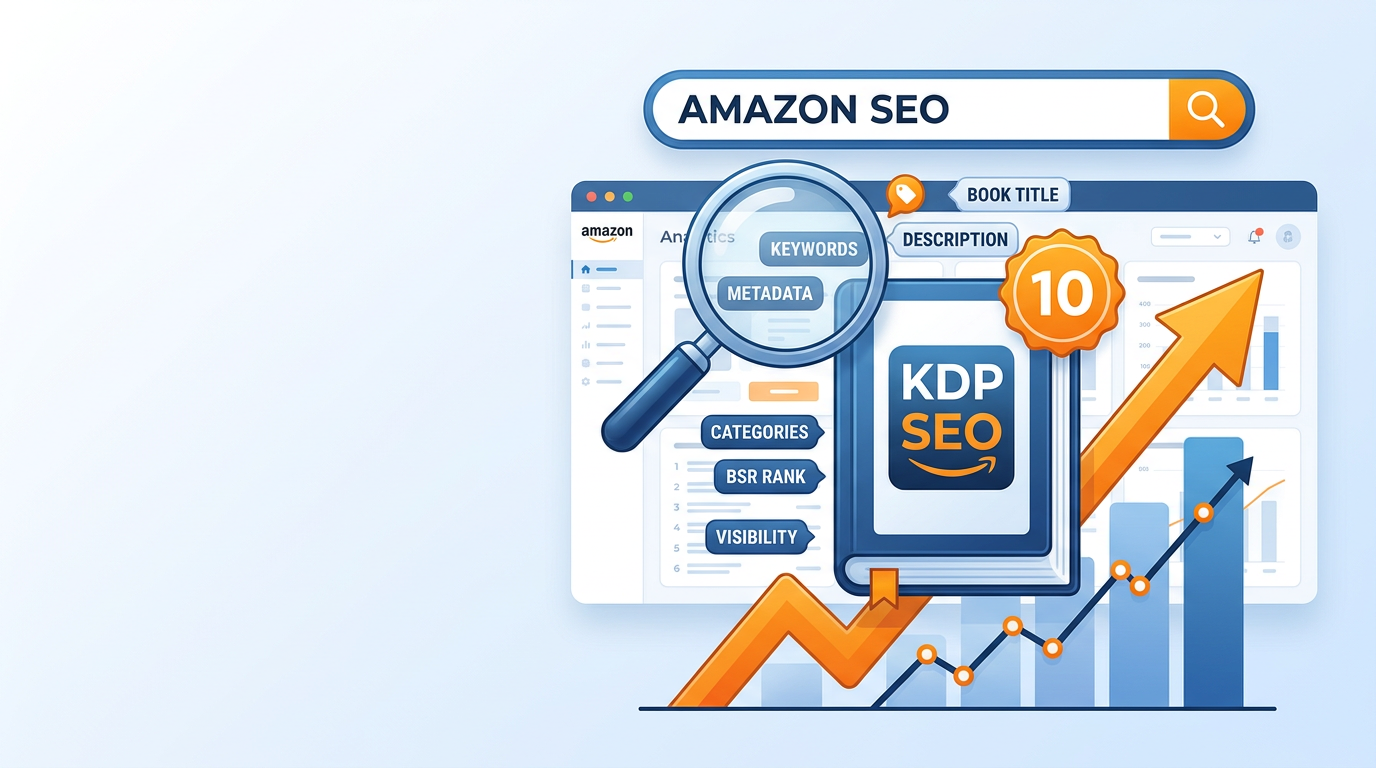
For independent publishers and self-published authors, the Amazon Kindle Direct Publishing (KDP) platform represents the world’s most powerful digital storefront. However, with over 30 million titles currently available on the platform, the "build it and they will come" philosophy no longer applies. To succeed, you must treat your book as a digital product that needs to be discovered by a specific search engine: the Amazon A10 algorithm.
Amazon SEO (Search Engine Optimization) is fundamentally different from Google SEO. While Google prioritizes information and relevance, Amazon prioritizes sales velocity. Every element of your book’s metadata—from the title to the backend keywords—must be engineered to convince the algorithm that your book is the most likely product to result in a purchase for a specific search query. In this comprehensive guide, we will dive deep into ten expert-level strategies to master Amazon KDP SEO and propel your book to the top of the search results.
1. Deciphering the Amazon A10 Algorithm: Sales is the Metric
To rank a book, you must first understand your "boss"—the Amazon A10 algorithm. Unlike Google, which focuses on backlinks and dwell time, Amazon cares about Conversion Rate (CVR). If 100 people click on your book and 10 people buy it, you have a 10% conversion rate. If a competitor has a 12% conversion rate for the same keyword, they will eventually outrank you, even if your book is "better" in a literary sense.
The A10 algorithm factors in several key metrics:
- Sales Velocity: How many units you sell in a specific window (e.g., the last 24 hours vs. the last 7 days).
- Click-Through Rate (CTR): The percentage of people who see your cover in search results and actually click on it.
- Customer Reviews: Both the quantity and the average star rating.
- Relevance: How well your metadata matches the user's search intent.
As a professional publisher, your goal is to optimize every piece of metadata to improve these metrics. Higher conversion leads to higher ranking, which leads to more organic sales—a phenomenon often called the "Amazon flywheel."
2. Advanced Keyword Research: Going Beyond the Obvious
Most authors make the mistake of choosing keywords that are either too broad (e.g., "fantasy book") or too niche (e.g., "steampunk dragon romance with a focus on historical clocks"). The secret to ranking lies in finding the "sweet spot": high search volume with manageable competition.
To find these "money keywords," you should use a multi-layered approach:
- Amazon Auto-Suggest: Start typing your main topic into the Amazon search bar and see what the dropdown suggests. These are real phrases customers are typing.
- Competitor Analysis: Look at the "best seller" lists in your category. Identify the phrases they use in their titles and subtitles.
- Keyword Combining: Use a Keyword Combiner to generate long-tail variations. For example, combining "Journal," "for Women," and "Self-Care" gives you specific targets that are easier to rank for than just "Journal."
Expert Tip: Focus on "Buyer Intent" keywords. A user searching for "how to fix a leaky faucet" is much more likely to buy a book than someone searching for "plumbing history." Always prioritize keywords that describe a solution or a very specific sub-genre.
3. Engineering Your Title and Subtitle for Maximum Impact
Your title is the most weighted piece of metadata in the Amazon algorithm. However, you must balance SEO with readability. A title that is just a string of keywords (keyword stuffing) looks unprofessional and can lead to lower click-through rates or even account suspension.
The "Front-Loading" Strategy: Place your most important, high-volume keyword at the very beginning of your title. For example, if your book is a guide on Keto, the title should ideally start with "Keto Diet Cookbook" rather than "Delicious Recipes for a Healthy Lifestyle: A Keto Diet Cookbook."
The subtitle is your opportunity to expand on your keywords and sell the "benefit" of the book.
"The Subtitle should bridge the gap between what the search engine wants (keywords) and what the human reader wants (value)."
Use the subtitle to include secondary keywords that didn't fit in the main title. If your title is "Morning Mastery," your subtitle could be "A 30-Day Guide to Productivity, Morning Routines, and Time Management for Entrepreneurs."
4. Mastering the 7 Backend Keyword Boxes
In the KDP dashboard, you are given seven boxes to input keywords. This is "invisible SEO" that helps Amazon categorize your book without cluttering your public-facing page. Many authors waste this space by repeating words already in their title. Do not repeat words. If "Keto" is in your title, you do not need it in your backend boxes.
Guidelines for the 7 Backend Boxes:
- Use Phrases: You can fit multiple words in one box. Instead of one box for "diet," use "low carb high fat recipes."
- Avoid Redundancy: Don't repeat keywords. Amazon's algorithm automatically combines words from different boxes.
- Include Synonyms: If your book is about "Budgeting," include "Money Management" or "Frugal Living" in the backend.
- Target Specific Audiences: Use boxes to define who the book is for, such as "gifts for teachers" or "books for teen boys."
5. Crafting a High-Conversion Description with HTML
While the Amazon description isn't a direct ranking factor for the A10 algorithm (unlike the title), it is the primary driver of Conversion Rate. A wall of plain text is difficult to read and looks amateurish. To rank higher, you need to convince more people to buy, and a professional description is key.
Use a professional HTML Description Formatter to add bold headings, bullet points, and italics. A well-structured description should follow the AIDA formula:
- Attention: A bold opening hook that addresses the reader's pain point or desire.
- Interest: Elaborate on what makes your book unique.
- Desire: Use bullet points to list the benefits or "what you will learn."
- Action: A clear Call to Action (CTA) like "Scroll up and click 'Buy Now' to start your journey."
6. Strategic Category Selection: The "Niche Down" Approach
Amazon recently updated its category system, allowing authors to choose three specific categories directly in the KDP dashboard. Choosing the right categories is vital because it determines your "Best Seller" badge potential. Ranking #1 in a very niche category is better for SEO than ranking #500 in a broad category like "Non-fiction."
When selecting categories:
- Look for categories where the top 10 books have a "Best Seller Rank" (BSR) that you can realistically compete with.
- Ensure the category is highly relevant. Misleading categories can lead to negative reviews, which destroy your ranking.
- Check the "path" of successful competitors. See exactly which sub-sub-categories they are listed in.
7. Visual SEO: Cover Design and CTR Optimization
Is cover design part of SEO? Absolutely. If your book appears at the top of the search results but nobody clicks on it, Amazon will quickly demote it. Your cover is your primary tool for increasing Click-Through Rate (CTR).
Technical perfection is the first step. Before designing your cover, use a Cover Calculator to ensure your dimensions are perfect for your page count. A blurry or ill-fitted cover screams "low quality" to both the algorithm and the customer.
Expert Advice for Covers:
- Thumbnail Test: Most Amazon shopping happens on mobile. Your title must be legible even when the cover image is the size of a postage stamp.
- Genre Expectations: Don't reinvent the wheel. If you are writing a thriller, use the fonts and color palettes common in high-ranking thrillers.
- Contrast: Ensure your title "pops" against the background.
8. Leveraging A+ Content to Boost Trust and Rank
A+ Content (the "From the Publisher" section on a book’s detail page) is a game-changer for conversion. While the text within A+ Content images isn't indexed for search, the Alt-Text you provide for those images is. This is a "hidden" SEO opportunity.
Beyond SEO, A+ Content allows you to show "inside the book," share your author's journey, or display a comparison table of your other titles. Increased dwell time on your product page and a higher conversion rate from A+ Content both signal to Amazon that your book is a high-quality product, leading to improved organic ranking.
9. Pricing Strategy and Its Impact on Sales Velocity
Pricing is a powerful lever for Amazon SEO. High sales volume is the fastest way to climb the rankings. If you are launching a new book, consider a "Launch Price" (e.g., $0.99 for an eBook) to generate a high volume of sales quickly. This "Sales Velocity" tells Amazon your book is popular, pushing it up the search results.
However, you must also be mindful of your margins. Use a Royalty Calculator to find the balance between a price that encourages high volume and a price that keeps your publishing business profitable. Once you have established a solid organic rank, you can gradually increase the price.
10. The Feedback Loop: Reviews and External Traffic
Reviews are the ultimate social proof. Amazon is hesitant to rank a book with zero reviews on the first page. While you cannot "buy" reviews, you can encourage them through:
- ARC (Advance Review Copy) Teams: Giving copies to readers before launch in exchange for honest reviews.
- Backmatter CTA: Including a polite request at the end of your book asking readers to leave a review.
Additionally, Amazon rewards books that bring "Outside Traffic" to the platform. If you send traffic from a Facebook ad, an email list, or a TikTok video directly to your Amazon page, the A10 algorithm gives your book an extra ranking boost. Amazon wants more customers, and if you are the one bringing them, they will reward you with higher visibility.
Common Amazon KDP SEO Mistakes to Avoid
Even experienced publishers fall into these traps. Avoid these common errors to protect your account and your rankings:
- Keyword Stuffing in the Title: "Weight Loss: Weight Loss for Women, Weight Loss for Men, Weight Loss Diet" will get your book rejected.
- Using Competitor Names: Including "Like Stephen King" in your backend keywords is a violation of Amazon’s Terms of Service.
- Ignoring Negative Feedback: If reviews mention formatting issues, fix them immediately. Low ratings will tank your SEO faster than any keyword can save it.
- Set It and Forget It: SEO is not a one-time task. Trends change, and keywords that worked last year may be oversaturated today.
Expert Insights: The Future of KDP Publishing
The landscape of KDP is shifting toward brand-building rather than just "keyword chasing." As AI-generated content floods the platform, Amazon is placing a higher premium on Author Authority. This means your "Author Central" profile, your professional website, and your consistent publishing history matter more than ever.
Successful publishers in 2024 and beyond are focusing on "Series SEO." By linking books together in a series, you create a "halo effect." When a reader searches for and buys Book 1, Amazon's algorithm begins suggesting Book 2 and Book 3 to similar customers, effectively automating your SEO through the "Customers Who Bought This Also Bought" section.
Conclusion: Your Actionable SEO Roadmap
Ranking higher on Amazon KDP is a marathon, not a sprint. To see real results, you must implement these strategies systematically. Start by performing a deep audit of your current keywords using the Keyword Combiner. Then, ensure your book’s presentation is flawless—calculate your cover dimensions with the Cover Calculator and format your description with the HTML Description Formatter.
Finally, monitor your results. Use a Royalty Calculator to track how your ranking improvements translate into actual profit. By focusing on conversion, relevance, and sales velocity, you can turn the Amazon algorithm from a mysterious obstacle into your most powerful marketing partner. Start optimizing today, and watch your titles climb the charts.
Be the first to leave a comment!